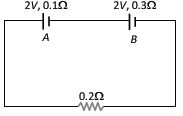
The internal resistances of two cells shown are $0.1\,\Omega $ and $0.3\,\Omega $. If $R = 0.2\,\Omega $, the potential difference across the cell
Medium
Download our app for free and get started
Applying Kirchhoff law
$(2+2)=(0.1+0.3+0.2)$ $\mathrm{i}$
$\Rightarrow \mathrm{i}=\frac{20}{3} \mathrm{A}$
Hence potential difference across $\mathrm{A}$
$=2-0.1 \times \frac{20}{3}=\frac{4}{3} \mathrm{\,V}$ [ less than $ 2 \mathrm{\,V}$]
Potential difference across
$B=2-0.3 \times \frac{20}{3}=0$

Download our appand get started for free
Experience the future of education. Simply download our apps or reach out to us for more information. Let's shape the future of learning together!No signup needed.*
Similar Questions
- 1A $10\,m$ long potentiometer wire has a potential gradient of $0.0025\, V/cm$. Calculate the distance of null point when the wire is connected to a $1.025\,V$ standard cell ............... $\mathrm{m}$View Solution
- 2Two bulbs of $500\, watt$ and $200\, watt$ are manufactured to operate on $220\, volt$ line. The ratio of heat produced in $500\, W$ and $200\, W$, in two cases, when firstly they are joined in parallel and secondly in series, will beView Solution
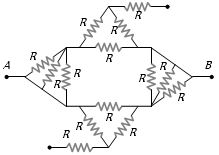
- 3Find equivalent resistance between $A$ and $B$View Solution
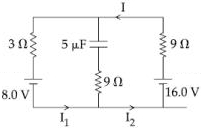
- 4The circuit shown here has two batteries of $8.0\,V$ and $16.0\,V$ and three resistors $3\,\Omega ,\,9\,\Omega $ and $9\,\Omega $ and a capacitor of $5.0\,\mu F.$View Solution
How much is the current $I$ in the circuit in steady state? ................... $A$
- 5A cell of $emf$ $E$ and internal resistance $r$ is connected in series with an external resistacne $nr.$ Then, the ratio of the terminal potential difference to $emf$ isView Solution
- 6In $n_e$ and $v_d$ be the number of electrons and drift velocity in a semiconductor. When the temperature is increasedView Solution
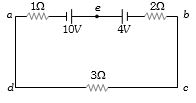
- 7View SolutionThe magnitude and direction of the current in the circuit shown will be
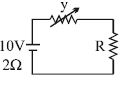
- 8In the figure shown the power generated in $y$ is maximum when $y = 5\,\Omega $. Then $R$ isView Solution
- 9We have a galvanometer of resistance $25\,\Omega $. It is shunted by a $2.5\,\Omega $ wire. The part of total current that flows through the galvanometer is given asView Solution
- 10If the current through a resistor in a circuit increases by $3 \%$, then the power dissipated by the resistorView Solution