Question
The interval on which the function $f(x) = 2x^3 + 9x^2 + 12x - 1$ is decreasing is:

Answer

We have, $f(x) = 2x^3 + 9x^2 + 12x - 1$
$\therefore f'(x) = 6x^2 + 18x + 12$
$= 6(x^2 + 3x + 2) = 6(x + 2)(x + 1)$
So, $\text{f}'(\text{x})\leq0,$ for decreasing.
On drawing number lines as below.
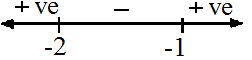
We see that $f'(x)$ is decreasing in $[-2, -1].$

Need a full question paper?

Generate a complete, print-ready paper with questions like this in minutes — across 16+ boards, with answer keys.

Start Generating Free

Similar questions

If $\vec{\text{a}}$ and $\vec{\text{b}}$ are unit vectors,then the greatest value of $\sqrt{3}\big|\vec{\text{a}}+\vec{\text{b}}\big|+\big|\vec{\text{a}}-\vec{\text{b}}\big|$ is:
  1. $2$
  2. $2\sqrt{2}$
  3. $4$
  4. $\text{None of these}$
A solution of the differential equation $\left(\frac{d y}{d x}\right)^2-x \frac{d y}{d x}+y=0$ is
For same order square matrix $A , B , C , AB = AC$ $\Rightarrow B=C$, then $A$ will be :
Domain of $\cos ^{-1}[x]$ (where [.] denotes G.I.F.) is
A person writes 4 letters and addresses 4 envelopes. If the letters are placed in the envelopes at random, then the probability that all letters are not placed in the right envelopes, is
  1. $\frac{1}{4}$
  2. $\frac{11}{14}$
  3. $\frac{15}{24}$
  4. $\frac{23}{24}$
Solution of the  differential equation $\frac{\text{dy}}{\text{dx}}+\frac{\text{y}}{\text{x}}=\sin\text{x}$ is:  
  1. $\text{x}(\text{y}+\cos\text{x})=\sin\text{x}+\text{C}$
  2. $\text{x}(\text{y}-\cos\text{x})=\sin\text{x}+\text{C}$
  3. $\text{x}(\text{y}+\cos\text{x})=\cos\text{x}+\text{C}$
  4. None of these.
In a binomial distribution, the probability of getting success is $\frac{1}{4}$ and standard deviation is 3. Then, its mean is:
  1. 6
  2. 8
  3. 12
  4. 10
The three points ABC have position vectors (1, x, 3), (3, 4, 7) and (y, -2, -5) are collinear then (x, y):
If $\text{f(x)}=\begin{cases}\frac{\log(1+\text{ax})-\log(1-\text{bx})}{\text{x}},&\text{x}\neq0\\\text{k},&\text{x}=0\end{cases}$ and f(x) is continous at x = 0, then the value of k is:
  1. a - b
  2. a + b
  3. $\log\text{a}+\log\text{b}$
  4. none of these
If $\sin(\text{x}+\text{y})=\log(\text{x}+\text{y}),$ then $\frac{\text{dy}}{\text{dx}}=$
  1. 2
  2. -2
  3. 1
  4. -1