MCQ
The isothermal elasticity of a gas is equal to
  • A
    Density
  • B
    Volume
  • Pressure
  • D
    Specific heat

Answer

Correct option: C.
Pressure
(c) 1sothermal elasticity $K_i=P$

Need a full question paper?

Generate a complete, print-ready paper with questions like this in minutes — across 16+ boards, with answer keys.
Start Generating Free

Similar questions

If $\varepsilon_0$ and $\mu_0$ are respectively, the electric permittivity and the magnetic permeability of free space, $\varepsilon$ and $\mu$ the corresponding quantities in a medium, the refractive index of the medium is
Unpolarized light of intensity $32 Wm$ passes through three polarizers such that transmission axes of the first and second polarizer makes and angle $30^{\circ}$ with each other and the transmission axis of the last polarizer is crossed with that of the first. The intensity of final emerging light will be
In $\text{S.H.M}$. maximum acceleration is at
The temperature of a piece of iron is $27^{\circ} \mathrm{C}$ and it is radiating energy at the rate of $Q \mathrm{kWm}^{-2}$. If its temperature is raised to $151^{\circ} \mathrm{C}$, the rate of radiation of energy will become approximately
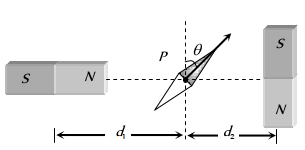
Two magnets $A$ and $B$ are identical and these are arranged as shown in the figure. Their length is negligible in comparison to the separation between them. A magnetic needle is placed between the magnets at point $P$ which gets deflected through an angle $\theta$ under the influence of magnets. The ratio of distance $d_1$ and $d_2$ will beImage
The force required to take away a flat circular plate of radius $2 \mathrm{~cm}$ from the surface of water, will be (the surface tension of water is 70 dyne/cm)
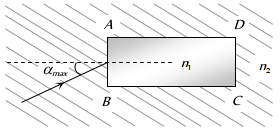
A rectangular glass slab $A B C D$, of refractive index $n$, is immersed in water of refractive index $n(n>n)$. A ray of light in incident at the surface $A B$ of the slab as shown. The maximum value of the angle of incidence $\alpha_{-}$, such that the ray comes out only from the other surface $C D$ is given by
Image
The maximum velocity and the maximum acceleration of a body moving in a simple harmonic oscillator are $2 m / s$ and $4 m / s ^2$. Then angular velocity will be
A body of mass $2 \mathrm{~kg}$ is kept by pressing to a vertical wall by a force of $100 \mathrm{~N}$. The coefficient of friction between wall and body is 0.3 . Then the frictional force is equal to
A particle is placed at the origin and a force $F=k x$ is acting on it (where $k$ is positive constant). If $U(0)=0$, the graph of $U(x)$ versus $x$ will be (where $U$ is the potential energy function)