MCQ
The $IUPAC$ name for $K_2[Cr(CN)_2O_2(O_2)NH_3]$ is
  • Potassium amminedicyanotetraoxo chromium $(III)$
  • B
    Potassium amminedicyanodioxygendioxo chromate $(IV)$
  • C
    Potassium amminedicyanosuperoxoperoxo chromate $(III)$
  • D
    Potassium amminedicyanodioxoperoxo chromate $(VI)$
Answer

Correct option: A.
Potassium amminedicyanotetraoxo chromium $(III)$
a
The $IUPAC$ name of the given complex is mercury tetrathiocyanatocobaltate $(II)$.

Need a full question paper?

Generate a complete, print-ready paper with questions like this in minutes — across 16+ boards, with answer keys.

Start Generating Free

Similar questions

Which of the following statement is not correct for an electron that has the quantum numbers $4 =$ and $m =2$
A pair of stereoisomers might be classified in various ways. Which of the  following statement are true with respect to pairs of stereoisomers?

$(a)$ They might be configurational isomers  $(b)$ They might be diastereomers
$(c)$ They might be constitutional isomers    $(d)$ They might be tautomers
$(e)$ They might be conformational isomers   $(f)$ They might be enantiomers
$(g)$ They might be positional isomers

The $pK_b$ of $C{N^\Theta }$ is $4.7.$ The $pH$ of solution prepared by mixing $2.5\,mol$ of $KCN$ and $2.5\,mol$ of $HCN$ in water and making the total volume upto $500\,mL$ is.
The unit of electrochemical equivalent is
The molar conductivity of $0.007 \,\mathrm{M}$ acetic acid is $20 \, \mathrm{~S} \, \mathrm{~cm}^{2} \,\mathrm{~mol}^{-1}$. What is the dissociation constant of acetic acid? (In $\times 10^{-5} \,\mathrm{~mol} \,\mathrm{~L}^{-1}$)

$[\Lambda_{\mathrm{H}^{+}}^{\circ}=350 \,\mathrm{~S}\, \mathrm{~cm}^{2}\, \mathrm{~mol}^{-1},\Lambda_{\mathrm{CH}_{3} \mathrm{COO}^{-}}^{\circ}=50\, \mathrm{~S}\, \mathrm{~cm}^{2}\, \mathrm{~mol}^{-1}]$

In mildly alkaline medium, thiosulphate ion is oxidized by $MnO _{4}^{-}$ to $"A".$ The oxidation state of sulphur in $"A"$ is ..... .
Predict the correct intermediate and product in the following reaction :

${H_3}C - C \equiv CH\,\xrightarrow[{HgS{O_4}}]{{{H_2}O,\,{H_2}S{O_4}}}\,\mathop {Intermediate}\limits_{(A)} \,$$ \to \,\mathop {\Pr oduct}\limits_{(B)} $

Given below are two statements:
Statement - I: High concentration of strong nucleophilic reagent with secondary alkyl halides which do not have bulky substituents will follow $S _{ N } 2$ mechanism.
Statement – II: A secondary alkyl halide when treated with a large excess of ethanol follows $S _{ N } 1$ mechanism.
In the the light of the above statements, choose the most appropriate from the questions given below: 
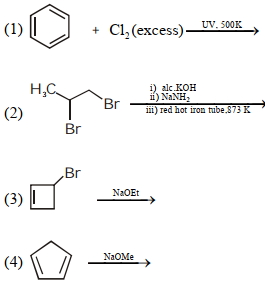
Choose the correct option($s$) that give($s$) an aromatic compound as the major product.
Rank the transition states that occur during the following reaction steps in order of
increasing stability (least $\to$ most stable)
$1. {{H}_{3}}C-\overset{+}{\mathop{O}}\,{{H}_{2}}\to CH_{3}^{+}+{{H}_{2}}O$
$2. (CH_3)_3 C - \overset{+}{\mathop{O}}\,{{H}_{2}} \to (CH_3)_3 C^+ + H_2O$
$3. (CH_3 )_2CH - \overset{+}{\mathop{O}}\,{{H}_{2}} \to (CH_3)_2 CH^+ + H_2O$