MCQ
The $IUPAC$ name for the coordination compound $Ba[BrF_4]_2$ is
- ABarium tetrafluorobromate $(V)$
- BBarium tetrafluorobromate $(III)$
- ✓Barium bis (tetrafluorobromate) $(III)$
- Dnone of these
$Z =$ Atomic number of the metal
$X =$ Number of electrons lost during the formation of the metal ion from its atom
$Y = Number$ of electrons donated by the ligands
$(i)$ For $\left.\left[ Ph _3 P \right)_2 PdCl _2\right] AN$ of $Pd =46-2+4 \times 2=52$.
The atomic number of xnon is 54 .
Hence, it does not follows EAN.
$(ii)$ For $[ NiBrCl ( en )], EAN$ of $Ni =28-2+8=34$.
The atomic number of krypton is 36 .
Hence, it does not follows EAN.
$(iii)$ For $Na _4\left[ Fe ( CN )_5 NOS \right], EAN$ of $Fe =26-2+5 \times 2+2=36$.
This is equal to the atomic number of krypton.
Hence, it follows EAN.
$(iv)$ For $Cr ( CO )_3( NO )_2, EAN$ of $Cr =24-0+3 \times 2+3 \times 2=36[ Kr ]$.
This is equal to the atomic number of krypton.
Hence, it follows $EAN.$
Generate a complete, print-ready paper with questions like this in minutes — across 16+ boards, with answer keys.
| Column $I$ | Column $II$ | ||
| $(A)$ | Kohlrausch law can calculate | $(P)$ | $\frac{{\Lambda _m^c}}{{\Lambda _m^o}}$ |
| $(B)$ | Molar conductance ${\Lambda _m}$ | $(Q)$ | $\frac{1}{R} \times \frac{l}{A}$ |
| $(C)$ | Specific conductance Kappa $\to (k)$ | $(R)$ | $\Lambda _m^o\,of\,c{a_3}{(P{O_4})_2}$ |
| $(D)$ | Degree of ionization of weak electrolyte | $(S)$ | $\frac{{k \times 1000}}{M}$ |
Which of the following option show correct matches

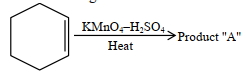
Product "$A$" is :