MCQ
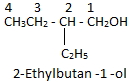
The $ IUPAC$ name of ${({C_2}{H_5})_2}CHC{H_2}OH$ is
  • $2-$ ethyl butanol $-1$
  • B
    $2-$ methyl pentanol $- 1$
  • C
    $2-$ ethyl pentanol $-1$
  • D
    $3-$ ethyl butanol $-1$

Answer

Correct option: A.
$2-$ ethyl butanol $-1$
a
The IUPAC nomenclature is done by determining the main carbon chain which contains the most active functional group. The longest hydrocarbon chain in the given compound consists of five carbon atoms, but it is not the main chain because it does not contain the functional group $(- OH )$. The other carbon chain consists of four carbon atoms with - $OH$ group. The carbon attached to the $- OH$ functional group is labeled as $1$. It is a saturated carbon chain, hence the word root with suffix is butanol. An alkyl group attached to the second carbon atom is 'ethyl' group. Therefore, the correct nomenclature is $2$-Ethylbutan-$1$-ol.

Need a full question paper?

Generate a complete, print-ready paper with questions like this in minutes — across 16+ boards, with answer keys.
Start Generating Free

Similar questions

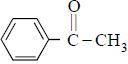
The $IUPAC$ name of given is :
In the equilibrium $AB$ $\rightleftharpoons$ $A + B$; if the equilibrium concentration of $A$ is doubled, the equilibrium concentration of $B$ would become:
A reaction having equal energies of activation for forward and reverse reactions has
Consider the following values of $IE(ev)$ for elements $W$ and $X$

Element  $IE_1$ $IE_2$ $IE_3$ $IE_4$
$W$ $10.5$ $15.5$ $24.9$ $79.8$
$X$ $8$ $14.8$ $78.9$ $105.8$

Other two elements $Y$ and $Z$ have outer electronic configuration $ns^2$ $np^4$ and $ns^2$ $np^5$ respectively. According to given information which of the following compound $(s)$ is/are not possible

$(a)\, W_2Y_3\, (b)\, X_2Y_3\, (c)\, WZ_2\, (d)\, XZ_2$
Which of the following compound $CANNOT$ act as a Lewis base ?

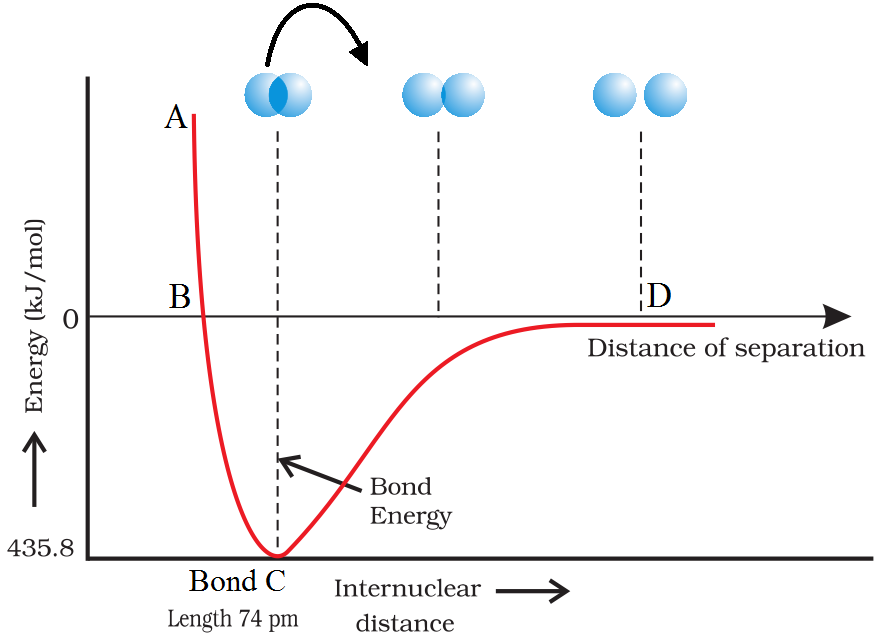
The above potential energy curve is given for the formation of H2 molecule as a function of internuclear distance of H-atoms. At what point in the curve H, is found in the most stable state?
Increasing order of stability of the $+2$ oxidation state of the ions ?
Which of the following reactions will yield $2, 2-$ dibromopropane?
Substance $A_2B(g)$ can undergoes decomposition to form two set of products If the molar ratio of $A_2(g)$ to $A(g)$ is $5 : 3$ in a set of product gases, then the energy involved in the decomposition of $1\, mole$ of $A_2B(g)$ is

${A_2}B(g) \to {A_2}(g) + B(g);\,\,\,\Delta {H^o} = 40\,kJ/mol$

${A_2}B(g) \to A(g) + AB(g);\,\,\,\Delta {H^o} = 50\,kJ/mol$

.....$ kJ/mol$

Given below are two statements : One is labelled as Assertion $A$ and the other is labelled as Reason $R$

Assertion $A$ : Thin layer chromatography is an adsorption chromatography.

Reason $R$: A thin layer of silica gel is spread over a glass plate of suitable size in thin layer chromatography which acts as an adsorbent. In the light of the above statements, choose the correct answer from the options given below.