MCQ
The $IUPAC$ name of 

$\begin{array}{*{20}{c}}
  {{{\left( {{C_2}{H_5}} \right)}_2}NC{H_2}CH \cdot COOH} \\ 
  {\,\,\,\,\,\,\,|} \\ 
  {\,\,\,\,\,\,\,Cl} 
\end{array}$

is :

  • A
    $2-$chloro$-4-N-$ethylpentanoic acid
  • $2-$chloro $-3-(N,N-$diethyl amino$)-$ propanoic acid
  • C
    $2-$chloro$-2-$oxo diethylamine
  • D
    $2-$chloro$-2-$carboxy$-N-$ethyl ethane

Answer

Correct option: B.
$2-$chloro $-3-(N,N-$diethyl amino$)-$ propanoic acid
b
$2-$chloro $-3-(N,N-$diethyl amino$)-$ propanoic acid

Need a full question paper?

Generate a complete, print-ready paper with questions like this in minutes — across 16+ boards, with answer keys.

Start Generating Free

Similar questions

Maximum number of atoms which are present in one plane of $H_3BO_3$?
$p$-Amino- $N, N$-dimethylaniline is added to a strongly acidic solution of ${X}$. The resulting solution is treated with a few drops of aqueous solution of ${Y}$ to yield blue coloration due to the formation of methylene blue. Treatment of the aqueous solution of ${Y}$ with the reagent potassium hexacyanoferrate$(II)$ leads to the formation of an intense blue precipitate. The precipitate dissolves on excess addition of the reagent. Similarly, treatment of the solution of ${Y}$ with the solution of potassium hexacyanoferrate$(III)$ leads to a brown coloration due to the formation of ${Z}$.

$1.$ The compound ${X}$ is

$(A)$ $\mathrm{NaNO}_3$ $(B)$ $\mathrm{NaCl}$ $(C)$ $\mathrm{Na}_2 \mathrm{SO}_4$ $(D)$ $\mathrm{Na}_2 \mathrm{~S}$

$2.$ The compound ${Y}$ is

$(A)$ $\mathrm{MgCl}_2$ $(B)$ $\mathrm{FeCl}_2$ $(C)$ $\mathrm{FeCl}_3$ $(D)$ $\mathrm{ZnCl}_2$

$3.$ The compound ${Z}$ is

$(A)$ $\left.\mathrm{Mg}_2 \mid \mathrm{Fe}(\mathrm{CN})_6\right]$ $(B)$ $\operatorname{Fe}\left[\mathrm{Fe}(\mathrm{CN})_6\right]$

$(C)$ $\mathrm{Fe}_4\left[\mathrm{Fe}(\mathrm{CN})_6\right]_3$ $(D)$ $\mathrm{K}_2 \mathrm{Zn}_3\left[\mathrm{Fe}(\mathrm{CN})_6\right]_2$

Give the answer question $1,2$ and $3.$
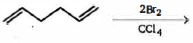
How many stereoisomeric tetrabromides will be formed in the following reaction ?
Given below are two statements : one is labelled as Assertion A and the other is labelled as Reason R: Assertion A : Aryl halides cannot be prepared by replacement of hydroxyl group of phenol by halogen atom.
Reason R : Phenols react with halogen acids violently. In the light of the above statements, choose the most appropriate from the options given below:
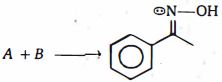
Reactant $(A)$ and $(B)$ is
The rate constant k, for the reaction ${N_2}{O_5}(g) \to $ $2N{O_2}(g) + \frac{1}{2}{0_2}(g)$ is $2.3 \times {10^{ - 2}}\,{s^{ - 1}}$. Which equation given below describes the change of $[{N_2}{O_5}]$ with time? ${[{N_2}{O_5}]_0}$ and ${[{N_2}{O_5}]_t}$ correspond to concentration of ${N_2}{O_5}$ initially and at time $t$.
Glucose and mannose are
The ionization energy of hydrogen atom is $ - 13.6\,eV.$ The energy required to excite the electron in a hydrogen atom from the ground state to the first excited state is (Avogadro’s constant $ = 6.022 × 10^{23}$)
Ail organic compound has $42.1 \%$ carbon, $6.4 \%$ hydrogen and remainder is oxygen. If its molecular weight is $342$ , then its molecular formula is:
$1, 2-$dibromoethane when heated with alcoholic potash gives