MCQ
The lamp whose working is based on a discharge tube is ________:
- AFluorescent lamp
- BIncandescent lamp
- CCFL
- DBoth (A) and (C)
Explanation:
Fluroscent lamp and compact fluroscent lamp works based on the low pressure gas discharge principle.
The glass tube if low pressure gas discharge lamp is filled with noble gas at low pressure and small quantity of mercury.
Generate a complete, print-ready paper with questions like this in minutes — across 16+ boards, with answer keys.
Retina of eye acts like ........ of camera
|
(a) Shutter |
(b) Film |
(c) Lens |
(d) None of these |
The specific resistance of a wire is ρ, its volume is 3  and its resistance is 3 ohms, then its length will be
|
(a) |
(b) |
(c) |
(d) |
Einstein's photoelectric equation states that  . In this equation
  refers to
|
(a) Kinetic energy of all the emitted electrons |
|
(b) Mean kinetic energy of the emitted electrons |
|
(c) Maximum kinetic energy of the emitted electrons |
|
(d) Minimum kinetic energy of the emitted electrons |
The current through a 4.6 H inductor is shown in the following graph. The induced emf during the time interval t = 5 milli-sec to 6 milli-sec will be
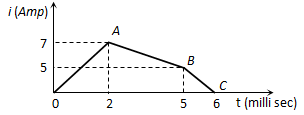
|
(a) 103 V |
(b) – 23 × 103 V |
(c) 23 × 103 V |
(d) Zero |
A cylindrical rod magnet has a length of 5 cm and a diameter of 1 cm. It has a uniform magnetisation of 5.30 × 10³Amp/m3. What its magnetic dipole moment
(a) 1 
|
(b) 2.08
|
(c) 3.08
|
(d) 1.52
|
What is the ratio of wavelength of radiations emitted when an electron in hydrogen atom jump from fourth orbit to second orbit and from third orbit to second orbit
| (a) 27 : 25 | (b) 20 : 27 |
(c) 20 : 25 |
(d) 25 : 27 |
The current conduction in a discharged tube is due to
|
(a) Electrons only |
(b) +ve ions and electrons |
|
(c) – ve ions and electrons |
(d) + ve ions, – ve ions and electrons |


