MCQ
The latent heat of vaporisation of water is $2240\, J/gm$. If the work done in the process of expansion of $1 \,g$ is $168 \,J$, then increase in internal energy is ....... $J$
  • A
    $2408 $
  • B
    $2240 $
  • $2072 $
  • D
    $1904 $

Answer

Correct option: C.
$2072 $
c
(c) $\Delta Q = \Delta U + \Delta W$$ \Rightarrow \Delta U = \Delta Q - \Delta W = 2240 - 168 = 2072\;J$.

Need a full question paper?

Generate a complete, print-ready paper with questions like this in minutes — across 16+ boards, with answer keys.
Start Generating Free

Similar questions

The maximum elongation of a steel wire of $1 \mathrm{~m}$ length if the elastic limit of steel and its Young's modulus, respectively, are $8 \times 10^8 \mathrm{~N} \mathrm{~m}^{-2}$ and $2 \times 10^{11} \mathrm{~N} \mathrm{~m}^{-2}$, is:
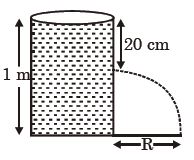
A tank is filled with water upto a height $1\,m$. A hole is made at a distance $20\, cm$ from top. Find, the horizontal distance from the base of the tank, where the water strikes the ground. ......... $cm$
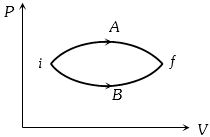
In the figure given two processes $A$ and $B$ are shown by which a thermo-dynamical system goes from initial to final state $F.$ If $\Delta {Q_A}$ and $\Delta {Q_B}$ are respectively the heats supplied to the systems then
In a stretched string,
$A$ body $A$ is thrown vertically upwards with such a velocity that it reaches a maximum height of $h$. Simultaneously another body $B$ is dropped from height $h$. It strikes the ground and does not rebound. The velocity of $A$ relative to $B v/s$ time graph is best represented by : (upward direction is positive)
Two particles having masses $4\, g$ and $16\, g$ respectively are moving with equal kinetic energies. The ratio of the magnitudes of their linear momentum is $n : 2 .$ The value of $n$ will be ...... .
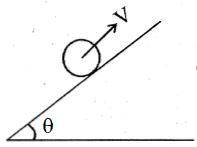
The sphere is performing rolling up an inclined plane, the frictional force is
A motor cyclist going round in a circular track at constant speed has
In the state of weightlessness, a capillary tube is dipped in water, then water
The $K.E.$ of a body becomes $4$ times its initial value. The new linear momentum will be: