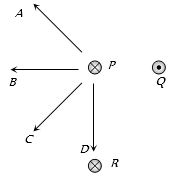
In figure shows three long straight wires $P, Q$ and $R$ carrying currents normal to the plane of the paper. All three currents have the same magnitude. Which arrow best shows the direction of the resultant force on the wire $P$
Easy
Download our app for free and get started
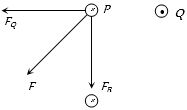
(c) The forces ${F_Q}$ and ${F_R}$ are the forces applies by wires $Q$ and $R$ respectively on the wire $P$ as shown in figure. Their resultant force $F$ is best shown by $C$.

Download our appand get started for free
Experience the future of education. Simply download our apps or reach out to us for more information. Let's shape the future of learning together!No signup needed.*
Similar Questions
- 1When a charged particle moving with velocity $\vec v$ is subjected to a magnetic field of induction $\vec B$, the force on it is non-zero. This implies thatView Solution
- 2At what distance for a long straight wire carrying a current of $12\, A$ will the magnetic field be equal to $3 \times 10^{-5} Wb / m ^{2}$ ?View Solution
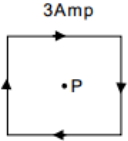
- 3Find magnetic field at centre $P$ if length of side of square loop is $20\, cm$View Solution
- 4When equal current is passed through two coils, equal magnetic field is produced at their centres. If the ratio of number of turns in the coils is $8: 15$, then the ratio of their radii will beView Solution
- 5View SolutionIf the current is doubled, the deflection is also doubled in
- 6A proton of mass $m$ and charge $+e$ is moving in a circular orbit in a magnetic field with energy $1\, MeV$. What should be the energy of $\alpha - $particle (mass = $4m$ and charge = $+ 2e),$ so that it can revolve in the path of same radius.......$MeV$View Solution
- 7A shunt of resistance $1\,\Omega $ is connected across a galvanometer of $120\,\Omega $ resistance. A current of $5.5\, ampere$ gives full scale deflection in the galvanometer. The current that will give full scale deflection in the absence of the shunt is nearly ............... $ampere$View Solution
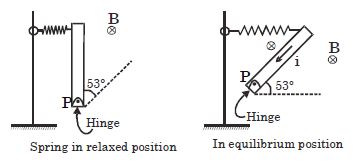
- 8A thin uniform rod with negligible mass and length $l$ is attached to the floor by a frictionless hinge at point $P$ . A horizontal spring with force constant $k$ connects the other end to wall. The rod is in a uniform magnetic field $B$ directed into the plane of paper. What is extension in spring in equilibrium when a current $i$ is passed through the rod in direction shown. Assuming spring to be in natural length initially.View Solution
- 9A metal ring of radius $r = 0.5 \,\,m $ with its plane normal to a uniform magnetic field $B$ of induction $0.2 T$ carries a current $I = 100\,\, A$. The tension in newtons developed in the ring is:View Solution
- 10One metre length of wire carries a constant current. The wire is bent to form a circular loop. The magnetic field at the centre of this loop is $B$. The same is now bent to form a circular loop of smaller radius to have four turns in the loop. The magnetic field at the centre of this new loop isView Solution