MCQ
The least count of the main scale of a vernier callipers is $1\, mm$. Its vernier scale is divided into $10$ divisions and coincide with $9$ divisions of the main scale. When jaws are touching each other, the $7$ th division of vernier scale coincides with a division of main scale and the zero of vernier scale is lying right side of the zero of main scale. When this vernier is used to measure length of a cylinder the zero of the vernier scale between $3.1\, cm$ and $3.2\, cm$ and $4^{th}$ $VSD$ coincides with a main scale division.The length of the cylinder is $.....cm$

($VSD$ is vernier scale division)

  • A
    $3.21$
  • B
    $2.99$
  • C
    $3.2$
  • $3.07$

Answer

Correct option: D.
$3.07$
d
Least count $=1 mm$ or $0.01 cm$

Zero error $=0+0.01 \times 7=0.07 cm$

Reading $=3.1+(0.01 \times 4)-0.07$

$=3.1+0.04-0.07$

$=3.1-0.03$

$=3.07 cm$

Need a full question paper?

Generate a complete, print-ready paper with questions like this in minutes — across 16+ boards, with answer keys.

Start Generating Free

Similar questions

Given below are two statements: One is labelled as Assertion $A$ and the other is labelled as Reason $R$.

Assertion $A$ : Product of Pressure $(P)$ and time $(t)$ has the same dimension as that of coefficient of viscosity.

Reason $R$ : Coefficient of viscosity $=\frac{\text { Force }}{\text { Velocity gradient }}$

Question : Choose the correct answer from the options given below 

In a particular system of units, a physical quantity can be expressed in terms of the electric charge $c$, electron mass $m_c$, Planck's constant $h$, and Coulomb's constant $k=\frac{1}{4 \pi \in_0}$, where $\in_0$ is the permittivity of vacuum. In terms of these physical constants, the dimension of the magnetic field is $[B]=[c]^\alpha\left[m_c\right]^\beta[h]^\gamma[k]^\delta$. The value of $\alpha+\beta+\gamma+\delta$ is. . . . .
A body has speed $V, 2\,V$ and $3\,V$ in first $1/3$ of distance $S$, second $1/3$ of $S$ and third $1/3$ of $S$ respectively. Its average speed will be :-
A mass $m$ is moving with a constant velocity along a line parallel to the $x-$axis away from the origin. Its angular momentum w.r.t. the origin is:
Two Carnot engines $A$ and $B$ are operated in series. The first one, $A,$ receives heat at $T_1(= 600\,K)$ and rejects to a reservoir at temperature $T_2.$ The second engine $B$ receives heat rejected by the first engine and, in turns, rejects to a heat reservoir at $T_3 (=400\,K).$ Calculate the temperature $T_2$ if the work outputs of the two engines are equal   ..... $K$
A car starts from rest and moves with uniform acceleration $'a'$ on a straight road from time $t = 0$ to $t = T$ . After that, a constant deceleration $'a'$ brings it to rest. In this process the average speed of the car is
$Assertion :$ Adiabatic expansion is always accompanied by fall in temperature.
$Reason :$ In adiabatic process, volume is inversely proportional to temperature.
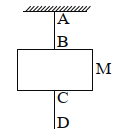
An object of mass $M$ is hung by a thread $A B$ and thread CD is hanging below the object. If end D is pulled down with a jerk then :
Image
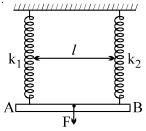
Two light vertical springs with equal natural lengths and spring constants $k_1$ and $k_2$ are separated by a distance $l$. Their upper ends are fixed to the ceiling and their lower ends to the ends $A$ and $B$ of a light horizontal rod $AB$. $A$ vertical downwards force $F$ is applied at point $C$ on the rod. $AB$ will remain horizontal in equilibrium if the distance $AC$ is 
A stone of mass $900 \mathrm{~g}$ is tied to a string and moved in a vertical circle of radius $1 \mathrm{~m}$ making $10\  \mathrm{rpm}$. The tension in the string, when the stone is at the lowest point is (if $\pi^2=9.8$ and $g=9.8 \mathrm{~m} / \mathrm{s}^2$ )