The length of a potentiometer wire is $\ell $. A cell of emf $E$ is balanced at a length $\ell /3$ from the positive end of the wire. If the length of the wire is increased by $\ell /2$ at what distance will the same cell give a balanced point
Medium


Download our appand get started for free
Experience the future of education. Simply download our apps or reach out to us for more information. Let's shape the future of learning together!No signup needed.*
Similar Questions
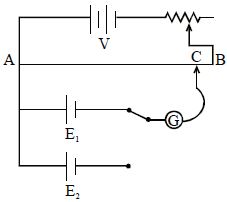
- 1The circuit shown here is used to compare the emf of two cells $E_1$ and $E_2 (E_1 > E_2)$. The null point is at $C$ when the galvanometer is connected to $E_1$. When the galvanometer is connected to $E_2$, the null point will beView Solution
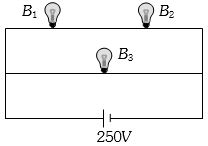
- 2A $100\, W$ bulb $B_1$, and two $60\,W$ bulbs $B_2$ and $B_3$, are connected to a $250\, V$ source, as shown in the figure. Now $ W_1, W_2$ and $W_3$ are the output powers of the bulbs $B_1, B_2$ and $B_3$, respectively. ThenView Solution
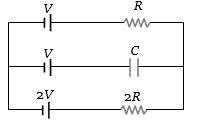
- 3View SolutionIn the given circuit, with steady current, the potential drop across the capacitor must be
- 4If current in an electric bulb changes by $1\%$, then the power will change by ............ $\%$View Solution
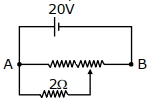
- 5the given potentiometer has its wire of resistance $10\, \Omega$. When the sliding contact is in the middle of the potentiometer wire, the potential drop across $2\, \Omega$ resistor is -View Solution
- 6When the resistance of $9 \,\Omega$ is connected at the ends of a battery, its potential difference decreases from $40\, volt$ to $30\, volt$. The internal resistance of the battery is ............... $\Omega$View Solution
- 7View SolutionThe maximum current that flows through a fuse wire before it blows out varies with its radius as
- 8A $60\, watt$ bulb operates on $220\,V$ supply. The current flowing through the bulb isView Solution
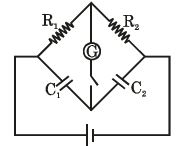
- 9View SolutionCircuit shown is in steady state, now when switch is closed, galvanometer shows no deflection, then correct relation is
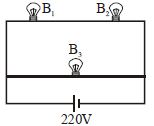
- 10A $100\, W \, bulb\, B_1$ and two $60\, W \,bulbs \,B_2$ and $B_3$, are connected to a $220\, V$ source, as shown in Figure. Now $P_1, P_2$ and $P_3$ are the output powers of the bulbs $B_1, B_2$ and $B_3$ respectively. ThenView Solution