MCQ
The length of Milky way is.......... light years
  • $100000$
  • B
    $10000 $
  • C
    $1000$
  • D
    $100 $

Answer

Correct option: A.
$100000$
a
(a) Length of milky way is $10^5$ light years.

Need a full question paper?

Generate a complete, print-ready paper with questions like this in minutes — across 16+ boards, with answer keys.

Start Generating Free

Similar questions

A particle of mass $m$ is moving with a uniform velocity $v_1$. It is given an impulse such that its velocity becomes $v_2$. The impulse is equal to
A concave lens and a convex lens have same focal length of $20 cm$ and both put in contact this combination is used to view an object $5 cm$ long kept at $20 cm$ from the lens combination. As compared to object the image will be
A musical scale is constructed by providing intermediate frequencies between a note and its octave which
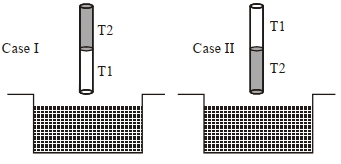
A cylindrical capillary tube of $0.2 mm$ radius is made by joining two capillaries $T 1$ and $T 2$ of different materials having water contact angles of $0^{\circ}$ and $60^{\circ}$, respectively. The capillary tube is dipped vertically in water in two different configurations, case I and II as shown in figure. Which of the following option($s$) is(are) correct?

(Surface tension of water $=0.075 N / m$, density of water $=1000 kg / m ^3$, take $g =10 m / s ^2$ )

$(1)$ The correction in the height of water column raised in the tube, due to weight of water contained in the meniscus, will be different for both cases.

$(2)$ For case I, if the capillary joint is $5 cm$ above the water surface, the height of water column raised in the tube will be more than $8.75 cm$. (Neglect the weight of the water in the meniscus)

$(3)$ For case $I$, if the joint is kept at $8 cm$ above the water surface, the height of water column in the tube will be $7.5 cm$. (Neglect the weight of the water in the meniscus)

$(4)$ For case II, if the capillary joint is $5 cm$ above the water surface, the height of water column raised in the tube will be $3.75 cm$. (Neglect the weight of the water in the meniscus)
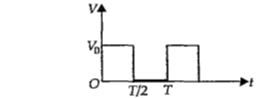
The $r.m.s.$ value of potential difference $V$ shown in the figure is 
The distance of the moon from earth is $3.8 \times {10^5}km.$ The eye is most sensitive to light of wavelength $5500 Å$. The separation of two points on the moon that can be resolved by a $500\ cm$ telescope will be......$m$
A monochromatic light is incident on a hydrogen sample in ground state. Hydrogen atoms absorb a fraction of light and subsequently emit radiation of six different wavelengths. The frequency of incident light is $x \times 10^{15}\,Hz$. The value of $x$ is (Given $h =4.25 \times 10^{-15}\,eVs$ )
The number density of molecules of a gas depends on their distance $r$ from the origin as, $n\left( r \right) = {n_0}{e^{ - \alpha {r^4}}}$. Then the total number of molecules is proportional to
A ray of light is incident on a $60^o$ prism at the minimum deviation position. The angle of refraction at the first face (i.e., incident face) of the prism is.......$^o$
Consider an ideal gas confined in an isolated closed chamber. As the gas undergoes an adiabatic expansion, the average time of collision between molecules increases as $V ^q$, where $V$ is the volume of the gas. The value of $q$ is $\left( {\gamma = \frac{{{C_P}}}{{{C_V}}}} \right)$