The length of the resistance wire is increased by $10\%$. What is the corresponding change in the resistance of wire ................ $\%$
Medium


Download our appand get started for free
Experience the future of education. Simply download our apps or reach out to us for more information. Let's shape the future of learning together!No signup needed.*
Similar Questions
- 1If you are provided three resistances $2 \,\Omega$, $3 \,\Omega$ and $6 \,\Omega$. How will you connect them so as to obtain the equivalent resistance of $4 \,\Omega$View Solution
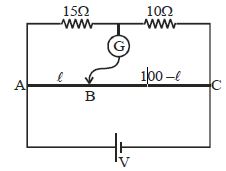
- 2In the meter bridge shown, the length $AB$ for which the deflection in galvanometer is zero will be ............. $cm$View Solution
- 3A resistor dissipates $192\, {J}$ of energy in $1\, {s}$ when a current of $4\, {A}$ is passed through it. Now, when the current is doubled, the amount of thermal energy dissipated in $5 \,{s}$ in $.....\,J.$View Solution
- 4The value of internal resistance of an ideal cell is $\Omega$View Solution
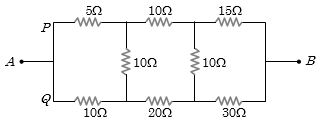
- 5In the arrangement of resistances shown below, the effective resistance between points $A$ and $B$ is ............... $\Omega$View Solution
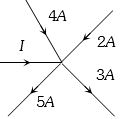
- 6In the given current distribution what is the value of $I$ .............. $A$View Solution
- 7View SolutionA heater coil is cut into two equal parts and only one part is now used in the heater. The heat generated will now be
- 8In the experiment of $Ohm's law,$ a potential difference of $5.0\, V$ is applied across the end of a conductor of length $10.0\, cm$ and diameter of $5.00\, mm .$ The measured current in the conductor is $2.00\, A$. The maximum permissible percentage error in the resistivity of the conductor isView Solution
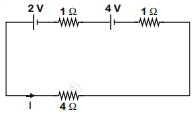
- 9For the circuit shown in the figure, the current $I$ will be .......$A$View Solution
- 10There are $8$ equal resistances $R$. Two are connected in parallel, such four groups are connected in series, the total resistance of the system will beView Solution