The value of internal resistance of an ideal cell is $\Omega$
Easy


Download our appand get started for free
Experience the future of education. Simply download our apps or reach out to us for more information. Let's shape the future of learning together!No signup needed.*
Similar Questions
- 1The resistance of a wire is $5\,ohm$ at $50\,^o C$ and $6\,ohm $ at $100\,^o C$. The resistance of the wire at $0\,^o C$ will be .............. $\Omega$View Solution
- 2View SolutionWhen current flows through a conductor, then the order of drift velocity of electrons will be
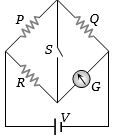
- 3In the circuit shown $P \ne R$, the reading of the galvanometer is same with switch $S$ open or closed. ThenView Solution
- 4Kirchhoff's first law $i.e.$ $\Sigma i = 0$ at a junction is based on the law of conservation ofView Solution
- 5A circuit of resistacne $R$ is connected to $n$ similar cells. If the current in the circuit is the same when the cells are connected in series or in parallel. If the internal resistacne $r$ of each cell thenView Solution
- 6View SolutionIn a sensitive meter bridge apparatus the bridge wire should possess
- 7The current in a wire varies with time according to relation $I = 4 + 2t$. The quantity of charge which has passed through a crosssectionn of the wire during the time $t = 2\, s$ to $t = 6\, s$ will be .............. $\mathrm{C}$View Solution
- 8At what temperature will the resistance of a copper wire become three times its value at $0\,^oC$ ................. $^oC$ (Temperature coefficient of resistance for copper = $4 × 10^{-3} \,per\, \,^oC$ )View Solution
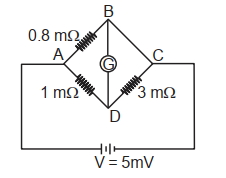
- 9To measure the temperature coefficient of resistivity $\alpha$ of a semiconductor, an electrical arrangement shown in the figure is prepared. The arm BC is made up of the semiconductor. The experiment is being conducted at $25^{\circ} \mathrm{C}$ and resistance of the semiconductor arm is $3 \mathrm{~m} \Omega$. Arm BC is cooled at a constant rate of $2^{\circ} \mathrm{C} / \mathrm{s}$. If the galvanometer $\mathrm{G}$ shows no deflection after $10 \mathrm{~s}$, then $\alpha$ is :View Solution
- 10Two bulbs are working in parallel order. Bulb $A$ is brighter than bulb $B$. If ${R_A}$ and ${R_B}$ are their resistance respectively thenView Solution