MCQ
The length, tension, diameter and density of a wire $B$ are double than the corresponding quantities for another stretched wire $A$. Then.
  • A
    The fundamental frequency of $A$ is equal to the third overtone of $B$
  • B
    The velocity of wave in $B$ is $\frac{1}{{\sqrt 2 }}$ times that of $A$. times that of velocity in $A.$
  • C
    The velocity of wave in $B$ is half that of velocity in $A$
  • both $(A)$ and $(c)$

Answer

Correct option: D.
both $(A)$ and $(c)$
d
We know,

$v =\sqrt{\frac{T}{\mu}}$

Also, $\mu \propto r^2$

Thus,

$v_A \propto \sqrt{\frac{T}{\rho(r)^2}}$

$v_B \propto \sqrt{\frac{2 T}{2 p(2 r)^2}}$

$v_B=\frac{v_A}{2}$

Also,

$n _{ S }=\frac{1}{2(2 L )} \sqrt{\frac{2 T }{8 \mu}}$

$n _{ S }=\frac{1}{8 L } \sqrt{\frac{ T }{\mu}}$

$n _{ A }=4 n _{ B }$

Need a full question paper?

Generate a complete, print-ready paper with questions like this in minutes — across 16+ boards, with answer keys.

Start Generating Free

Similar questions

An air bubble of radius $0 .1\, cm$ is in a liquid having surface tension $0.06\, N/m$ and density $10^3\, kg/m^3$. The pressure inside the bubble is $1100\, Nm^{-2}$ greater than the atmospheric pressure. At ....... $m$ depth is the bubble below the surface of the liquid ? $(g\, = 9.8\, ms^{- 2})$
The maximum acceleration of a particle in $SHM$ is made two times keeping the maximum speed to be constant. It is possible when
Sound waves of wavelength $\pi$ travelling in a medium with a speed of $v\ m/ s$ enter into another medium where its speed is $2v\ m/ s$. Wavelength of sound waves in the second medium is:
A $1 \;kg$ stationary bomb is exploded in three parts having mass $1: 1: 3$ respectively. Parts having same mass move in perpendicular direction with velocity $30\; ms ^{-1}$, then the velocity of bigger part will be
A piece of glass is heated to a high temperature and then allowed to cool. If it cracks, a probable reason for this is the following property of glass
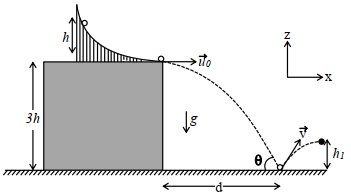
A slide with a frictionless curved surface, which becomes horizontal at its lower end,, is fixed on the terrace of a building of height $3 h$ from the ground, as shown in the figure. A spherical ball of mass $\mathrm{m}$ is released on the slide from rest at a height $h$ from the top of the terrace. The ball leaves the slide with a velocity $\vec{u}_0=u_0 \hat{x}$ and falls on the ground at a distance $d$ from the building making an angle $\theta$ with the horizontal. It bounces off with a velocity $\overrightarrow{\mathrm{v}}$ and reaches a maximum height $h_l$. The acceleration due to gravity is $g$ and the coefficient of restitution of the ground is $1 / \sqrt{3}$. Which of the following statement($s$) is(are) correct?

($AV$) $\vec{u}_0=\sqrt{2 g h} \hat{x}$ ($B$) $\vec{v}=\sqrt{2 g h}(\hat{x}-\hat{z})$  ($C$) $\theta=60^{\circ}$  ($D$) $d / h_1=2 \sqrt{3}$

The circular scale of a micrometer has $200$ divisions and pitch of $2\,mm$ . Find the measured value of thickness of a thin sheet .......... $mm$
A person moves $30\, m$ north and then $20\, m$ towards east and finally $30\sqrt 2 \,m$  in south-west direction. The displacement of the person from the origin will be
Two objects are projected with same velocity ' $u$ ' however at different angles $\alpha$ and $\beta$ with the horizontal. If $\alpha+\beta=90^{\circ}$, the ratio of horizontal range of the first object to the $2^{\text {nd }}$ object will be :
A truck and a car are moving with equal velocity. On applying the brakes both will stop after certain distance, then