Question
The light emitted in the transition n = 3 to n = 2 in hydrogen is called $\text{H}_\alpha$ light. Find the maximum work function a metal can have so that $\text{H}_\alpha$ light can emit photoelectrons from it.

Answer

$n_1 = 2, n_2 = 3$ Energy possessed by $\text{H}_\alpha$ light$=13.6\bigg(\frac{1}{\text{n}^2_1}-\frac{1}{\text{n}^2_2}\Big)$
$=13.6\times\Big(\frac{1}{4}-\frac{1}{9}\Big)$
$=1.89\text{ev}$
For $\text{H}_\alpha$ light to be able to emit photoelectrons from a metal the work function must be greater than or equal to 1.89ev.

Need a full question paper?

Generate a complete, print-ready paper with questions like this in minutes — across 16+ boards, with answer keys.
Start Generating Free

Similar questions

Why parallax method cannot be used for measuring distances of stars more than 100 light years away?
Why is the weight of a body at the poles more than the weight at the equator? Explain.
A liquid has a definite volume but no shape of its own. Explain.
Is earth inertial or non-inertial frame of reference?
A block of wood is floating on water at 0°C with a certain volume x above the level of water. The temperature of water is gradually increased from 0°C to 8°C. How does the volume x change with change in temperature?
A newly designed thermometer has its lower fixed point and upper fixed point marked 5°C and 95°C respectively. Compute the temperature on this scale corresponding to 50°C.
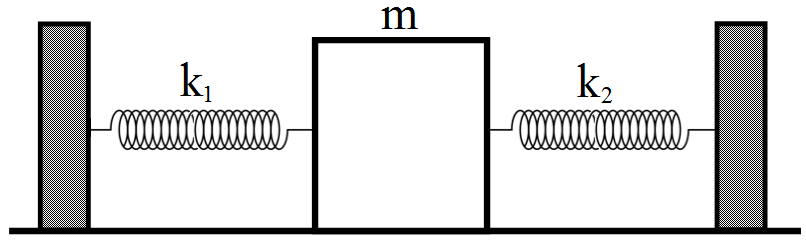
Both the springs shown in figure are unstretched. If the block is displaced by a distance x and released, what will be the initial acceleration?
A pendulum having time period equal to two seconds is called a seconds pendulum. Those used in pendulum clocks are of this type. Find, the length of a seconds pendulum at a place where $\text{g}=\pi^2\text{m/s}^2.$
Two syringes of different cross$-$sections $($without needles$)$ filled with water are connected with a tightly fitted rubber tube filled with water. Diameters of the smaller piston and larger piston are $1.0\ cm$ and $3.0\ cm$ respectively.
  1. Find the force exerted on the larger piston when a force of $10N$ is applied to the smaller piston.
  2. If the smaller piston is pushed in through $6.0\ cm$, how much does the larger piston move out?
Is physics more of a philosophy or more of a mathematical science?