MCQ
The light source will be coherent if :
- ✓The phase difference remains fixed at their place of origin
- BThey should have the same amplitude
- CTheir frequency should be same
- DAll the above mentioned things are present.
Generate a complete, print-ready paper with questions like this in minutes — across 16+ boards, with answer keys.
Which of the following is constructed on the principle of electromagnetic induction
|
(a) Galvanometer |
(b) Electric motor |
(c) Generator |
(d) Voltmeter |
A group of N cells whose emf varies directly with the internal resistance as per the equation EN = 1.5 rN are connected as shown in the figure below. The current I in the circuit is
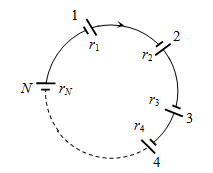
|
(a) 0.51 amp |
(b) 5.1 amp |
(c) 0.15 amp |
(d) 1.5 amp |
Boron rods in nuclear reactor are used as a
|
(a) Moderator |
(b) Control rods |
(c) Coolants |
(d) Protective shield |
In a wave, the path difference corresponding to a phase difference of f is
|
(a) |
(b) |
(c) |
(d) |
The refractive index of a prism for a monochromatic wave is  and its refracting angle is 60°. For minimum deviation, the angle of incidence will be
|
(a) 30° |
(b) 45° |
(c) 60° |
(d) 75° |
A radioactive material has a half-life of 8 years. The activity of the material will decrease to about 1/8 of its original value in
|
(a) 256 year |
(b) 128 year |
(c) 64 year |
(d) 24 year |


