The limiting friction between two bodies in contact is independent of
Easy
Download our app for free and get started
(b)
Independent of the area of the surface in contact. [Note that viscous force is proportional to the area

Download our appand get started for free
Experience the future of education. Simply download our apps or reach out to us for more information. Let's shape the future of learning together!No signup needed.*
Similar Questions
- 1A cylinder of mass $10\,kg$ is sliding on a plane with an initial velocity of $10\,m/s$. If coefficient of friction between surface and cylinder is $ 0.5$, then before stopping it will describe ............. $\mathrm{m}$View Solution
- 2$Assertion$ : There is a stage when frictional force is not needed at all to provide the necessary centripetal force on a banked road.View Solution
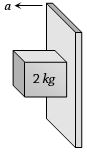
$Reason$ : On a banked road, due to its inclination the vehicle tends to remain inwards without any chances of skidding. - 3A rough vertical board has an acceleration $‘a’$ so that a $2$ kg block pressing against it does not fall. The coefficient of friction between the block and the board should beView Solution
- 4A plank is resting on a horizontal ground in the northern hemisphere of the earth at a $45^{\circ}$ latitude. Let the angular speed of the earth be $\omega$ and its radius $r_e$. The magnitude of the frictional force on the plank will beView Solution
- 5A block of mass $2\,kg$ moving on a horizontal surface with speed of $4\,ms ^{-1}$ enters a rough surface ranging from $x =0.5\,m$ to $x =1.5\,m$. The retarding force in this range of rough surface is related to distance by $F =- kx$ where $k =12\,Nm ^{-1}$. The speed of the block as it just crosses the rough surface will be ........... $\,ms ^{-1}$View Solution
- 6A hemispherical bowl of radius $r$ is set rotating about its axis of symmetry in vertical. A small block kept in the bowl rotates with bowl without slipping on its surface. If the surface of the bowl is smooth and the angle made by the radius through the block with the vertical is $\theta$, then find the angular speed at which the ball is rotating.View Solution
- 7A stone of mass $0.25\; kg$ tied to the end of a string is whirled round in a circle of radius $1.5 \;m$ with a speed of $40\; rev./min$ in a hortzontal plane. What is the tenston in the string? What is the maximum speed in $m/s $ with which the stone can be whirled around if the string can withstand a maximum tension of $200\; N ?$View Solution
- 8A $20\, kg$ block is initially at rest on a rough horizontal surface. A horizontal force of $75 \,N$ is required to set the block in motion. After it is in motion, a horizontal force of $60\, N$ is required to keep the block moving with constant speed. The coefficient of static friction isView Solution
- 9A block of mass $5\,kg$ is placed at rest on a table of rough surface. Now, if a force of $30\,N$ is applied in the direction parallel to surface of the table, the block slides through a distance of $50\,m$ in an interval of time $10\,s$. Coefficient of kinetic friction is (given, $g =10\,ms ^{-2}$)View Solution
- 10A block of mass $2 kg$ slides down an incline plane of inclination $30^o$. The coefficient of friction between block and plane is $0.5$. The contact force between block and plank is :View Solution