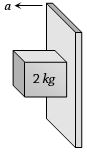
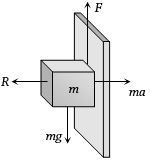
A rough vertical board has an acceleration $‘a’$ so that a $2$ kg block pressing against it does not fall. The coefficient of friction between the block and the board should be
Medium


Download our appand get started for free
Experience the future of education. Simply download our apps or reach out to us for more information. Let's shape the future of learning together!No signup needed.*
Similar Questions
- 1If a ladder weighing $250\,N$ is placed against a smooth vertical wall having coefficient of friction between it and floor is $0.3$, then what is the maximum force of friction available at the point of contact between the ladder and the floor ........ $N$View Solution
- 2......... $m/s^2$ is magnitude of acceleration of a block moving with speed $10\,m/s$ on a rough surface if coefficient of friction is $0.2$.View Solution
- 3View SolutionA cyclist taking turn bends inwards while a car passenger taking same turn is thrown outwards. The reason is
- 4A plank is resting on a horizontal ground in the northern hemisphere of the earth at a $45^{\circ}$ latitude. Let the angular speed of the earth be $\omega$ and its radius $r_e$. The magnitude of the frictional force on the plank will beView Solution
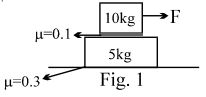
- 5The maximum $"F"$ which will not cause motion of any of the blocks. ...... $N$View Solution
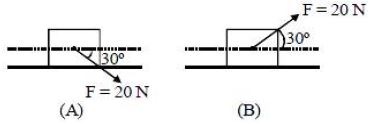
- 6A heavy box is solid across a rough floor with an initial speed of $4 \,m / s$. It stops moving after $8$ seconds. If the average resisting force of friction is $10 \,N$, the mass of the box (in $kg$ ) is .....View Solution
- 7The maximum speed that can be achieved without skidding by a car on a circular unbanked road of radius $R$ and coefficient of static friction $\mu $, isView Solution
- 8Aball of mass $m$ is thrown vertically upwards.Assume the force of air resistance has magnitude proportional to the velocity, and direction opposite to the velocity's. At the highest point, the ball's acceleration isView Solution
- 9View SolutionA car travels north with a uniform velocity. It goes over a piece of mud which sticks to the tyre. The particles of the mud, as it leaves the ground are thrown
- 10A block of mass $5\, kg$ is $(i)$ pushed in case $(A)$ and $(ii)$ pulled in case $(B)$, by a force $F = 20\, N$, making an angle of $30^o$ with the horizontal, as shown in the figures. The coefficient of friction between the block and floor is $\mu = 0.2$. The difference between the accelerations of the block, in case $(B)$ and case $(A)$ will be ........ $ms^{-2}$ .$(g = 10\, ms^{-2})$View Solution