MCQ
The limiting friction is
  • Always greater than the dynamic friction
  • B
    Always less than the dynamic friction
  • C
    Equal to the dynamic friction
  • D
    Sometimes greater and sometimes less than the dynamic friction

Answer

Correct option: A.
Always greater than the dynamic friction
a
Limiting friction is the maximum static friction which comes into play when the body is just at the point of motion. Once the sliding has begun, the two surfaces have not sufficient time to fully settle down and hence cavities will not fully interlock and we require lesser force to keep the body in motion. Hence we can say that it is always greater than dynamic friction.

Need a full question paper?

Generate a complete, print-ready paper with questions like this in minutes — across 16+ boards, with answer keys.

Start Generating Free

Similar questions

A student measuring the diameter of a pencil of circular cross-section with the help of a vernier scale records the following four readings $5.50\, mm , 5.55\, mm ,$$ 5.45\, mm ; 5.65\, mm .$ The average of these four readings is $5.5375\, mm$ and the standard deviation of the data is $0.07395\, mm .$ The average diameter of the pencil should therefore be recorded as
What is the rate of change of rate of change of displacement of a body?
An open tank filled with water (depsity $\rho$ ) has a narrow hole at a depth of h below the water surface. The velocity of water flowing out is
What is the restoring force proportional to in simple harmonic motion?
An ideal gas is expanding such that ${PT}^{3}=$ constant. The coefficient of volume expansion of the gas is:
An aeroplane flying at a constant velocity releases a bomb.As the bomb drops down from the aeroplane,
$STATEMENT-1$ It is easier to pull a heavy object than to push it on a level ground. and

$STATEMENT-2$ The magnitude of frictional force depends on the nature of the two surfaces in contact.
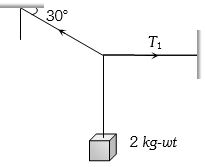
A body of weight $2\, kg$ is suspended as shown in the figure. The tension ${T_1}$ in the horizontal string (in kg wt) is
A ring is suspended from a point $S$ on its rim as shown in the figure. When displaced from equilibrium, it oscillates with time period of $1\,second.$ The radius of the ring is ..... $m$ (take $g = \pi ^2$ )
A big ball of mass $M$, moving with velocity $u$ strikes a small ball of mass $m$, which is at rest. Finally small ball obtains velocity $u$ and big ball $v$. Then what is the value of $v$