MCQ
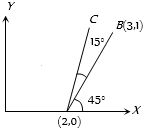
The line joining two points $A(2,0), B(3,1)$ is rotated about $A$ in anti-clockwise direction through an angle of ${15^o}$. The equation of the line in the new position, is
  • $\sqrt 3 x - y - 2\sqrt 3 = 0$
  • B
    $x - 3\sqrt y - 2 = 0$
  • C
    $\sqrt 3 x + y - 2\sqrt 3 = 0$
  • D
    $x + 3\sqrt y - 2 = 0$

Answer

Correct option: A.
$\sqrt 3 x - y - 2\sqrt 3 = 0$
a
(a) Here slope of $AB = \frac{1}{1} \Rightarrow \tan \theta = {m_1} = 1$or $\theta = {45^o}$.
Thus slope of new line is $\tan ({45^o} + {15^o}) = \tan {60^o} = \sqrt 3 $
{It is rotated anticlockwise so the angle will be ${45^o} + {15^o} = {60^o}$}
Hence the equation is $y = \sqrt 3 x + c$, but it still passes through (2,0), hence $c = - 2\sqrt 3 $.
Thus required equation is
 

Need a full question paper?

Generate a complete, print-ready paper with questions like this in minutes — across 16+ boards, with answer keys.

Start Generating Free

Similar questions

The value of $\mathop {\lim }\limits_{x \to \infty } {\left( {\frac{{3x - 4}}{{3x + 2}}} \right)^{\frac{{x + 1}}{3}}}$ is equal to
Let the mean and the variance of $5$ observations $x_{1}, x_{2}, x_{3}, x_{4}, x_{5}$ be $\frac{24}{5}$ and $\frac{194}{25}$ respectively. If the mean and variance of the first $4$ observation are $\frac{7}{2}$ and $a$ respectively, then $\left(4 a+x_{5}\right)$ is equal to
The value of $\left| {\,\begin{array}{*{20}{c}}a&{a + b}&{a + 2b}\\{a + 2b}&a&{a + b}\\{a + b}&{a + 2b}&a\end{array}\,} \right|$ is equal to
$\int_{}^{} {{x^3}\sqrt {3 + 5{x^4}} } \;dx = $
If the domain of the function
$f(x)=\log _{7}\left(1-\log _{4}\left(x^{2}-9 x+18\right)\right)$ is $(\alpha, \beta) \cup(\gamma, \delta)$, then $\alpha+\beta+\gamma+\delta$ is equal to
If $\omega $ be a complex cube root of unity, then $\left| {\,\begin{array}{*{20}{c}}1&\omega &{ - {\omega ^2}/2}\\1&1&1\\1&{ - 1}&0\end{array}\,} \right| = $
The area (in sq. units) of the region $\mathrm{S}=\{\mathrm{z} \in \mathbb{C} ;|\mathrm{z}-1| \leq 2 ;(\mathrm{z}+\overline{\mathrm{z}})+\mathrm{i}(\mathrm{z}-\overline{\mathrm{z}}) \leq 2, \operatorname{lm}(\mathrm{z}) \geq 0\}$ is
If the function $y = e^{4x} + 2e^{-x}$ is a solution of the differential equation $\frac{{\frac{{{d^3}y}}{{d{x^3}}} - 13\frac{{dy}}{{dx}}}}{y} = K$ then the value of $K$ is
Let $f\left( x \right) = \left\{ \begin{array}{l} \max \left\{ {\left| x \right|,{x^2}} \right\},\,\,\,\,\left| x \right| \le 2\\ 8 - 2\left| x \right|,\,\,\,\,\,\,\,\,\,\,\,\,\,\,\,2 < \left| x \right| \le 4\,\,\,\, \end{array} \right.$. Let $S$ be the set of points in the interval $(-4, 4)$ at which $f$ is not differentiable. Then $S$
A particle moves along a straight line so that its distance $ s $ in time $ t$ sec is $s = t + 6{t^2} - {t^3}$. After what time is the acceleration zero .......... $\sec$.