MCQ
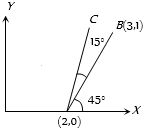
The line joining two points $A(2,0), B(3,1)$ is rotated about $A$ in anti-clockwise direction through an angle of ${15^o}$. The equation of the line in the new position, is
  • $\sqrt 3 x - y - 2\sqrt 3 = 0$
  • B
    $x - 3\sqrt y - 2 = 0$
  • C
    $\sqrt 3 x + y - 2\sqrt 3 = 0$
  • D
    $x + 3\sqrt y - 2 = 0$

Answer

Correct option: A.
$\sqrt 3 x - y - 2\sqrt 3 = 0$
a
(a) Here slope of $AB = \frac{1}{1} \Rightarrow \tan \theta = {m_1} = 1$or $\theta = {45^o}$.
Thus slope of new line is $\tan ({45^o} + {15^o}) = \tan {60^o} = \sqrt 3 $
{It is rotated anticlockwise so the angle will be ${45^o} + {15^o} = {60^o}$}
Hence the equation is $y = \sqrt 3 x + c$, but it still passes through (2,0), hence $c = - 2\sqrt 3 $.
Thus required equation is
 

Need a full question paper?

Generate a complete, print-ready paper with questions like this in minutes — across 16+ boards, with answer keys.

Start Generating Free

Similar questions

If $a=\sqrt{2i}$ then which of the following is correct [Roorkee 1989]
If $f(x)=x \sin x$, then $f^{\prime}\left(\frac{\pi}{2}\right)$ is equal to
There are five students $S_1, S_2, S_3, S_4$ and $S_5$ in a music class and for them there are five seats $R_1, R_2, R_3, R_4$ and $R_5$ arranged in a row, where initially the seat $R_i$ is allotted to the student $S_i$, $i =1,2,3,4,5$. But, on the examination day, the five students are randomly allotted the five seats.

($1$) The probability that, on the examination day, the student $S_1$ gets the previously allotted seat $R_1$, and $NONE$ of the remaining students gets the seat previously allotted to him/her is

$(A)$ $\frac{3}{40}$ $(B)$ $\frac{1}{8}$ $(C)$ $\frac{7}{40}$ $(D)$ $\frac{1}{5}$

($2$) For $i =1,2,3,4$, let $T _{ i }$ denote the event that the students $S _{ i }$ and $S _{ i +1}$ do NOT sit adjacent to each other on the day of the examination. Then, the probability of the event $T _1 \cap T _2 \cap T _3 \cap T _4$ is

$(A)$ $\frac{1}{15}$ $(B)$ $\frac{1}{10}$ $(C)$ $\frac{7}{60}$ $(D)$ $\frac{1}{5}$

Give the answer or quetion ($1$) and ($2$)
If $x$ is a real number and $|x|<3$, then
The domain of the function $^{7-\text{x}}\text{p}_{\text{x}-3}$ is:
The coefficient of $x$ in the equation ${x^2} + px + q = 0$was taken as $17$ in place of $13$, its roots were found to be $-2$ and $-15$, The roots of the original equation are
If ${A_1},\,{A_2}$ be two arithmetic means between $\frac{1}{3}$ and $\frac{1}{{24}}$ , then their values are
If $\lim _{x \rightarrow 0} \frac{\log (3+x)-\log (3-x)}{x}= K$, then value of K is equal to :
The value of $\sin \frac{\pi }{{14}}\sin \frac{{3\pi }}{{14}}\sin \frac{{5\pi }}{{14}}\sin \frac{{7\pi }}{{14}}\sin \frac{{9\pi }}{{14}}\sin \frac{{11\pi }}{{14}}\sin \frac{{13\pi }}{{14}}$ is equal to
If lines $4x + 3y = 1,y = x + 5$ and $5y + bx = 3$ are concurrent, then $b$ equals