Question
The line segment joining $A (2, 3)$ and $B (6, -5)$ is intercepted by $x-$ axis at the point $K.$ Write down the ordinate of the point $K.$ Hence, find the ratio inwhich $K$ divides $AB.$ Also find the coordinates of the point $K.$

Answer

Since, point $K$ lies on x-axis, its ordinate is $0.$
Let the point $K (x, 0)$ divides $AB$ in the ratio $k: 1.$
We have,
$y=\frac{k \times(-5)+1 \times 3}{k+1}$
$0=\frac{-5 k+3}{k+1}$
$k=\frac{3}{5}$
Thus, K divides AB in the ratio $3: 5.$
Also, we have:
$x=\frac{k \times 6+1 \times 2}{k+1}$
$x=\frac{\frac{3}{5} \times 6+2}{\frac{3}{5}+1}$
$x=\frac{18+10}{3+5}$
$x=\frac{28}{8}=\frac{7}{2}=3 \frac{1}{2}$
Thus, the co-ordinates of the point $K$ are $\left(3 \frac{1}{2}, 0\right)$

Need a full question paper?

Generate a complete, print-ready paper with questions like this in minutes — across 16+ boards, with answer keys.
Start Generating Free

Similar questions

Draw two circles of radii 3.5 cm and 2 cm respectively so that their centres are 6 cm apart. Draw direct common tangents to the circle and show that they are equal in length.
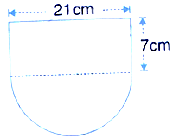
The given figure shows the cross section of a water channel consisting of a rectangle and a semicircle.Assuming that the channel is always full, find the volume of water discharged through itin one minute if water is flowing at the rate of $20 \ cm$ per second. Give your answer in cubicmetres correct to one place of decimal.
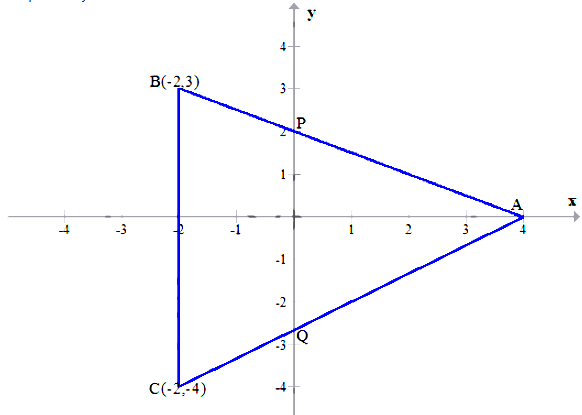
In the figure, ABC is a triangle and BC is parallel to the y-axis. AB and AC intersect the y-axis at P and Q respectively.

(1) Write the co-ordinates of A.
(2) Find the length of Ab and AC.
(3) Find the radio in which Q divides Ac.
(4)find the equation of the line AC.
Draw two circles with radii 2.5 cm and 4 cm and with their centres 7 cm apart.
Draw a direct common tangent and a transverse common tangent. Calculate the length of the direct common tangent. 
Draw a histogram for the following distribution and estimate the mode: 
Marks% 30-39 40-49 50-59 60-69 70-79 80-89 90-99
No. of students 14 26 40 92 114 78 36
If $a, b, c$ and dare in continued proportion, then prove that
$(a+ d)(b+ c)-(a+ c)(b+ d)$
$= (b-c)^2$
Prove the following trigonometric identities.
$sec A\  (1 − \sin A) (sec\  A + \tan A) = 1$
The bisectors of the opposite angles A and C of a cydic quadrilateral ABCD intersect the cirde at the points E and F, respectively. Prove that EF is a diameter of the circle.
Prove the following trigonometric identities.$\frac{\cos A}{1-\tan A}+\frac{\sin A}{1-\cot A}=\sin A+\cos A$
A cylindrical beaker of 7 cm diameter is partly filled with water. Determine the number of spherical marbles of diameter 1.4 cm that are to be submerged in it to raise the water level by 5.6 cm