Question 14 Marks
$A(-8, 0), B(0, 16)$ and $C(0, 0)$ are the verticals of a triangle $ABC.$ Point $P$ lies on $AB$ and $Q$ lies on $AC$ such that $AP : PB = 3 : 5$ and $AQ : QC = 3 : 5$ Show that : PQ =$\frac{3}{8}$ BC
AnswerGiven that, point $P$ lies on $AB$ such that $AP: PB = 3: 5.$
The co-ordinates of point $P$ are
$\left(\frac{3 \times 0+5 \times(-8)}{3+5}, \frac{3 \times 16+5 \times 0}{3+5}\right)$
$=\left(-\frac{40}{8}, \frac{48}{8}\right)$
$=(-5,6)$
Also, given that, point $Q$ lies on $AB$ such that $AQ: QC = 3: 5.$
The co-ordinates of point $Q$ are
$\left(\frac{3 \times 0+5 \times(-8)}{3+5}, \frac{3 \times 0+5 \times 0}{3+5}\right)$
$=\left(-\frac{40}{8}, \frac{0}{8}\right)$
$=(-5,0)$
Using distance formula,
$P Q=\sqrt{(-5+5)^2+(0-6)^2}=\sqrt{0+36}=6$
Hence, proved
$B C=\sqrt{(0-0)^2+(0-16)^2}=\sqrt{0+16^2}=16$
$\text { Now } PQ =\frac{3}{8} BC$
$=\frac{3}{8} \times 16$
$PQ =6$
View full question & answer→Question 24 Marks
A(20, 0) and B(10, -20) are two fixed points Find the co-ordinates of the point P in AB such that : 3PB = AB, Also, find the co-ordinates of some other point Q in AB such that AB = 6 AQ.
AnswerGiven, 3PB =AB
$\Rightarrow \frac{A B}{P B}=\frac{3}{1}$
$\Rightarrow \frac{A B-P B}{P B}=\frac{3-1}{1}$
$\Rightarrow \frac{A P}{P B}=\frac{2}{1}$
Using section formula,
Coordinates of P are
$P(x, y)=P\left(\frac{2 \times 10+1 \times 20}{2+1}, \frac{2 \times(-20)+1 \times 0}{2+1}\right)$
$=P\left(\frac{40}{3},-\frac{40}{3}\right)$
Given, AB = 6AQ
$\Rightarrow \frac{A Q}{A B}=\frac{1}{6}$
$\Rightarrow \frac{A Q}{A B-A Q}=\frac{1}{6-1}$
$\Rightarrow \frac{A Q}{Q B}=\frac{1}{5}$
Using section formula,
Coordinates of Q are
$Q(x, y)=Q\left(\frac{1 \times 10+5 \times 20}{1+5}, \frac{1 \times(-20)+5 \times 0}{1+5}\right)$
$=Q\left(\frac{110}{6},-\frac{20}{6}\right)$
$=Q\left(\frac{55}{3},-\frac{10}{3}\right)$
View full question & answer→Question 34 Marks
A(3, 1), B(y, 4) and C(1, x) are vertices of a triangle ABC. P, Q and R are mid - points of sides BC, CA and AB respectively. Show that the centroid of ΔPQR is the same as the centroid ΔABC.
AnswerCentroid of $\triangle ABC =\left(\frac{3+y+1}{3}, \frac{1+4+x}{3}\right)=\left(\frac{4+y}{3}, \frac{5+x}{3}\right)$
$P, Q$ and $R$ are the mid points of the sides $BC, CA$ and $AB.$
By mid - point formula, we get
$\Rightarrow P=\left(\frac{y+1}{2}, \frac{4+x}{2}\right), Q=\left(\frac{4}{2}, \frac{1+x}{2}\right)$ and $R=\left(\frac{3+y}{2}, \frac{5}{2}\right)$
Centroid of a $\triangle PQR =\left(\frac{\frac{y+1}{2}+\frac{4}{2}+\frac{3+y}{2}}{3}, \frac{\frac{4+x}{2}-\frac{1+x}{2}+\frac{5}{2}}{3}\right)$
$=\left(\frac{\frac{y+1+4+3+y}{2}}{3}, \frac{\frac{4+x+1+x+5}{2}}{3}\right)$
$=\left(\frac{8+2 y}{6}, \frac{10+2 x}{6}\right)$
$=\left(\frac{4+y}{3}, \frac{5+x}{3}\right).....(2)$
From (i) and (ii), we get
Centroid of a $\triangle ABC =$ Centroid of a $\triangle PQR$
View full question & answer→Question 44 Marks
M is the mid-point of the line segment joining the points A(0,4) and B(6,0). M also divides the line segment OP in the ratio 1:3 find :
(a) co-ordinates of M
(b) Co-ordinates of P
(c) Length Of BP
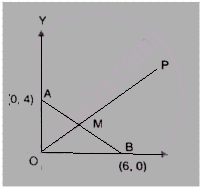
Answera. $M$ is the mid -point of line segment joining point $A(0,4)$ and $B(6,0)$.
$\therefore M=\left(0+\frac{6}{2}, 4+\frac{0}{2}\right)=(3,2)$
b. $M$ divides OP in the ratio $1: 3$
Let the coordinates of $P$ be $(x, y)$
$\therefore M=\left(\frac{x+0}{1+3}, \frac{y+0}{1+}\right)=\left(\frac{x}{4}, \frac{y}{4}\right)$
But, $M=(3,2)$
$\therefore \frac{x}{4}=3$ and $\frac{y}{4}=2$
$\Rightarrow x=12$ and $y=8$
$\therefore$ coordinates of $P$ are $(12,8)$
$C \cdot B P=\sqrt{(12-6)^2+(8-0)^2}=\sqrt{6^2+8^2}=\sqrt{36+64}=\sqrt{100}=10$ unit
View full question & answer→Question 54 Marks
The line joining the points $(2,1)$ and $(5,-8)$ is trisected at the point $P$ and $Q,$ point $P$ lies on the line $2 x-y+k=0$, find the value of $k$ Also, find the co-ordinates of point $Q.$
AnswerLet $A(2,1)$ and $B (5,-8)$ be the given point trisected by the points $P$ and $Q$
$\Rightarrow A P=P Q=Q B$
$f \text { or } P:$
$m_1: m_2=A P: P B=1: 2$
$\left(x_1 y_1\right)=(2,1)$ and $\left(x_2, y_2\right)=(5,8)$
$\therefore \frac{x=1 \times 5+2 \times 2}{1+2}=\frac{5+4}{3}=\frac{9}{3}=3$
$y=\frac{1 \times(-8)+2 \times 1}{1+2}=\frac{-8+2}{3}=-\frac{6}{3}=-2$
$\therefore$ Coordinates of $P$ are $(3,2)$
Since point $P$ line on the line $2 x-y+k=0$
$2(3)-(-2)+k=0$
$\Rightarrow 6+2+k=0$
$\Rightarrow f$ or $0$
$m_1: m_2=A Q: Q B=2: 1$
$\left(x_1 y_1\right)=(2,1)$ and $\left(x_2, y_2\right)=(5,-8)$
$\therefore x=\frac{2 \times 5+1 \times 2}{2+1}=\frac{10+2}{3}=\frac{12}{3}=4$
$y=\frac{2 \times(-8)+1 \times 1}{1+2}=\frac{-16+1}{3}=\frac{-15}{3}=-5$
$\therefore$ Cocrdinates of $Q$ are $(4,-5)$
View full question & answer→Question 64 Marks
Calculate the ratio in which the line joining A$(-4,2)$ and B$(3,6)$ is divided by point p$(x,3).$ Also, find $x$
AnswerLet P $(x,3)$ divides the line segment joining the points
A$(-4,2)$ and B$(3,6)$ in the ratio $K:1.$
Thus , we have
$\frac{3 k-4}{k+1}=x ; \quad \frac{6 k+2}{k+1}=3$
for
$6 k+2=3(k+1)$
$\Rightarrow 6 k+2=3 k+3 $
$ \Rightarrow 3 k=3-2 $
$ \Rightarrow 3 k=1 \Rightarrow k=\frac{1}{3}$
$\therefore$ Required ratio $1: 3$
a now consider the quation $\frac{3 k-4}{k+1}=x$
Substituting the value of k in the above equation, We have
$\frac{3 \times \frac{1}{3}-4}{\frac{1}{3}+1}=x \Rightarrow-\frac{3}{\frac{4}{3}}=x \Rightarrow-\frac{9}{4}=x$
$\therefore x=-\frac{9}{4}$
b. $A P=\sqrt{\left(\frac{-9}{4}+4\right)^2+(3-2)^2}=\sqrt{\frac{49}{16}+1}=\frac{\sqrt{49+16}}{16}=\sqrt{\frac{65}{16}}$
$\Rightarrow A P=\frac{\sqrt{65}}{4}$ unit
View full question & answer→Question 74 Marks
M is the mid-point of the line segment joining the points A$(-3, 7)$ and B$(9, -1).$ Find the coordinates of point M. Further, if R$(2, 2)$ divides the line segment joining M and the origin in the ratio $p : q,$ find the ratio $p : q$
AnswerGiven, M is the mid-point of the line segment joining the points A$(−3, 7)$ and B$(9, −1).$ The co-ordinates of point M are
$\left(\frac{-3+9}{2}, \frac{7-1}{2}\right) $
$ =\left(\frac{6}{2}, \frac{6}{2}\right)$
$ =(3,3)$
Also, given that, R $(2, 2)$ divides the line segment joining M and the origin in the ratio $p : q.$
$\therefore(2,2)=\left(\frac{p \times 0+q \times 3}{p+q}, \frac{p \times 0+q \times 3}{p+q}\right)$
$\Rightarrow \frac{p \times 0+q \times 3}{p+q}=2$
$ \Rightarrow \frac{3 q}{p+q}=2 $
$ \Rightarrow 3 q=2 p+2 q $
$ \Rightarrow 3 q-2 q=2 p $
$ \Rightarrow q=2 p $
$ \Rightarrow \frac{p}{q}=\frac{1}{2}$
Thus the ratio $p : q$ is $1 : 2.$
View full question & answer→Question 84 Marks
Prove that the points $A(-5, 4); B(-1, -2)$ and $C(5, 2)$ are the vertices of an isosceles right angled triangle. Find the co-ordinates of $D$ so that $ABCD$ is a square.
AnswerWe have:
$A B=\sqrt{(-1+5)^2+(-2-4)^2}=\sqrt{16+36}=\sqrt{52}$
$B C=\sqrt{(-1+5)^2+(-2-2)^2}=\sqrt{36+16}=\sqrt{52}$
$A C=\sqrt{(5+5)^2+(2-4)^2}=\sqrt{100+4}=\sqrt{104}$
$A B^2+B C^2=52+52=104$
$A C^2=104$
$\because A B=B C A N d A B^2+B C^2=A C^2$
$\because ABC$ is an isosceles right-angled triangle.
Let the coordinates of $D$ be $(x, y).$
If $ABCD$ is a square, then,
Mid-point of $AC =$ Mid-point of $BD$
$((-5+5)/(2),(4+2)/(2))=((x-1)/(2),(y-2)/(2))$
$0=\frac{x-1}{2}, 3=\frac{y-2}{2}$
$x = 1, y = 8$
Thus, the co-ordinates of point $D$ are $(1, 8).$
View full question & answer→Question 94 Marks
(i) write down the co-ordinates of the point $P$ that divides the line joining $A(-4, 1)$ and $B(17, 10)$ in the ratio $1 : 2.$
(ii) Calculate the distance $OP,$ where $O$ is the origin.
(iii) In what ratio does the $Y-$ axis divide the line $AB?$
Answer(i) Co-ordinates of point P are
$\left(\frac{1 \times 17+2 \times(-1)}{1+2}, \frac{1 \times 10+2 \times 1}{1+2}\right)$
$=\left(\frac{17-8}{3}, \frac{10+2}{3}\right)$
$=\left(\frac{9}{3}, \frac{12}{3}\right)$
$=(3,4)$
(ii) $O P=\sqrt{(0-3)^2+(0-4)^2}$
$O P=\sqrt{9+16}$
$O P=\sqrt{25}$
$O P=5$ units
(iii) Let AB be divided by the point $P(0, y)$ lying on y-axis in the ratio
$\therefore(0, y)=\left(\frac{k \times 17+1 \times(-4)}{k+1}, \frac{k \times 10+1 \times 1}{k+1}\right)$
$\Rightarrow(0, y)=\left(\frac{17 k-4}{k+1}, \frac{10 k+1}{k+1}\right)$
$\Rightarrow 0=\frac{17 k-4}{k+1}$
$\Rightarrow 17 k-4=0$
$\Rightarrow k=\frac{4}{17}$ Thus, the ratio in which the y-axis divide the line $AB$ is $4: 17.$
View full question & answer→Question 104 Marks
The mid point of the line segment joining $(4a, 2b -3)$ and $(-4, 3b)$ is $(2, -2a).$ Find the values of $a$ and $b.$
AnswerIt is given that the mid-point of the line-segment joining $(4a, 2b - 3)$ and $(-4, 3b)$ is $(2, -2a).$
$\therefore(2,-2 a)=\left(\frac{4 a-4}{2}, \frac{2 b-3+3 b}{2}\right)$
$ \Rightarrow 2=\left(\frac{4 a-4}{2}\right)$
$\Rightarrow 2=\left(\frac{4 a-4}{2}\right) $
$\Rightarrow 4 a-4=4$
$ \Rightarrow 4 a=8$
$\Rightarrow a=2$
Also,
$-2 a=\frac{2 b-3+3 b}{2} $
$ \Rightarrow-2 \times 2=\frac{5 b-3}{2} $
$ \Rightarrow 5 b-3=-8$
$\Rightarrow 5 b=-5$
$ \Rightarrow b=-1$
View full question & answer→Question 114 Marks
Given a line $ABCD$ in which $AB = BC = CD, B= (0, 3)$ and $C = (1, 8)$
Find the co-ordinates of $A$ and $D.$
Answer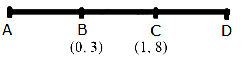
Given, $AB = BC = CD$
So, $B$ is the mid-point of $AC.$ Let the co-ordinates of point $A$ be $(x, y).$
theref or $(0,3)=\left(\frac{x+1}{2}, \frac{y+8}{2}\right)$
$\Rightarrow 0=\frac{x+1}{2} \text { and } 3=\frac{y+8}{2}$
$\Rightarrow 0=x+1 \text { and } 6=y+8$
$\Rightarrow-1=x \text { and }-2=y$
Thus, the co-ordinates of point $A$ are $(-1, -2).$
Also, $C$ is the mid-point of $BD.$ Let the co-ordinates of point $D$ be $(p, q).$
$\therefore(1,8)=\left(\frac{0+p}{2}, \frac{3+q}{2}\right)$
$\Rightarrow 1=\frac{0+p}{2} \text { and } 8=\frac{3+q}{2}$
$\Rightarrow 2=0+p \text { and } 16=3+q$
$\Rightarrow 2=p \text { and } 13=q$
Thus, the co-ordinates of point $D$ are $(2, 13).$ View full question & answer→Question 124 Marks
$(-5, 2), (3, -6)$ and $(7, 4)$ are the vertices of a triangle. Find the length of its median through the vertex $(3, -6)$
AnswerLet A $(-5, 2),$ B $(3, -6)$ and C$(7, 4)$ be the vertices of the given triangle. Let AD be the median through A, BE be the median through B and CF be the median through C.
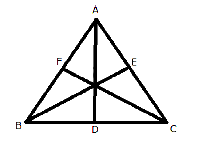
We know that median of a triangle bisects the opposite side.
Co-ordinates of point F are
$\left(\frac{-5+3}{2}, \frac{2-6}{2}\right)=\left(-\frac{2}{2},-\frac{4}{2}\right)=(-1,-2)$
Co-ordinates of point D are
$\left(\frac{3+7}{2}, \frac{-6+4}{2}\right)=\left(\frac{10}{2},-\frac{2}{2}\right)=(5,-1)$
Co-ordinates of point E are
$\left(\frac{-5+7}{2}, \frac{2+4}{2}\right)=\left(\frac{2}{2}, \frac{6}{2}\right)=(1,3)$
The median of the triangle through the vertex B$(3, -6)$ is BE
Using distance formula,
$B E=\sqrt{(1-3)^2+(3+6)^2}$
$ B E=\sqrt{4+81} $
$B E=\sqrt{85} $
$ B E=9.22$ View full question & answer→Question 134 Marks
A $(5, 3),$ B$(-1, 1)$ and C$(7, -3)$ are the vertices of triangle ABC. If L is the mid-point of AB and M is the mid-point of AC, show that $LM =1/2BC$
AnswerGiven, L is the mid-point of AB and M is the mid-point of AC.
Co-ordinates of L are
$\left(\frac{5-1}{2}, \frac{3+1}{2}\right)=(2,2)$
Co-ordinates of M are
$\left(\frac{5+7}{2}, \frac{3-3}{2}\right)=(6,0)$
Using distance formula, we have:
$B C=\sqrt{(7+1)^2+(3-1)^2} $
$ B C=\sqrt{64+16}$
$B C=\sqrt{80} $
$ B C=4 \sqrt{5}$
$ L M=\sqrt{(6-2)^2+(0-2)^2} $
$ L M=\sqrt{16+4}$
$ L M=\sqrt{20} $
$L M=2 \sqrt{5}$
Hence. $L M=\frac{1}{2} B C$
View full question & answer→Question 144 Marks
$P (4, 2)$ and $Q (-1, 5)$ are the vertices of parallelogram $PQRS$ and $(-3, 2)$ are the co-ordinates of the point of intersection of its diagonals. Find co-ordinates of $R$ and $S.$
Answer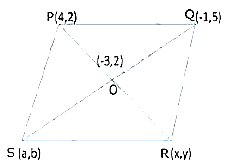
Let the coordinates of $R$ and $S$ be $(x, y)$ and $(a, b)$ respectively.
Mid-point of $PR$ is $O.$
$\therefore O(-3,2)=O\left(\frac{4+x}{2}, \frac{2+y}{2}\right)$
$-3=\frac{4+x}{2}, 2=\frac{2+y}{2}$
$-6=4+x, 4=2+y$
$x=-10, y=2$
Hence, $R = (−10,2)$
Similarly, the mid-point of $SQ$ is $O.$
$\therefore O(-3,2)=O\left(\frac{a-1}{2}, \frac{b+5}{2}\right)$
$-3=\frac{a-1}{2}, 2=\frac{b+5}{2}$
$-6=a-1,4=b+5$
$a=-5, b=-1$
Hence, $S=(-5,-1)$
Thus, the coordinates of the point $R$ and $S$ are $(-10, 2)$ and $(-5, -1).$ View full question & answer→Question 154 Marks
Points $A, B, C$ and $D$ divide the line segment joining the point $(5, -10)$ and the origin in five equal parts. Find the co-ordinates of $B$ and $D.$
Answer
Point $A$ divides $PO$ in the ratio $1: 4.$
Co-ordinates of point A are:
$\left(\frac{1 \times 0+4 \times 5}{1+4}, \frac{1 \times 0+4 \times(-10)}{1+4}\right)$
$=\left(\frac{20}{5},-\frac{40}{5}\right)$
$=(4,-8)$
Point $B$ divides $PO$ in the ratio $2: 3.$
Co-ordinates of point $B$ are:
$\left(\frac{2 \times 0+3 \times 5}{2+3}, \frac{2 \times 0+3 \times(-10)}{2+3}\right)$
$=\left(\frac{15}{5},-\frac{30}{5}\right)$
$=(3,-6)$
Point $C$ divides $PO$ in the ratio $3: 2.$
Co-ordinates of point $C$ are:
$\left(\frac{3 \times 0+2 \times 5}{3+2}, \frac{3 \times 0+2 \times(-10)}{3+2}\right)$
$=\left(\frac{10}{5},-\frac{20}{5}\right)$
$=(2,-4)$
Point $D$ divides $PO$ in the ratio $4: 1.$
Co-ordinates of point $D$ are:
$\left(\frac{4 \times 0+1 \times 5}{4+1}, \frac{4 \times 0+1 \times(-10)}{4+1}\right)$
$=\left(\frac{5}{5},-\frac{10}{5}\right)$
$=(1,-2)$ View full question & answer→Question 164 Marks
If $P(-b, 9a - 2)$ divides the line segment joining the points $A(-3, 3a + 1)$ and $B(5, 8a)$ in the ratio $3: 1,$ find the values of $a$ and $b.$
AnswerTake $(x_1 , y_1) = (-3, 3a + 1) ; (x_2 , y_2) = B(5, 8a)$ and
$(x, y) = (-b, 9a - 2)$
Here $m_1 = 3$ and $m_2 =1$
Coordinate of $P ( x , y )=\left(\frac{m_1 x_2+m_2 x_1}{m_1-m_2}, \frac{m_1 y_2+m_2 y_1}{m_1+m_2}\right)$
$\Rightarrow x=\frac{m_1 x_2+m_2 x_1}{m_1-m_2}$ and $y=\frac{m_1 y_2+m_2 y_1}{m_1+m_2}$
$\Rightarrow-b=\frac{3 \times 5+1 \times(-3)}{3+1} \text { and } 9 a-2=\frac{3 \times 8 a+1(3 a+1)}{3+1}$
$\Rightarrow-b=\frac{15-3}{4} \text { and } 9 a-2=\frac{24 a+3 a+1}{4}$
$\Rightarrow-4 b=12 \text { and } 36 a-8=27 a+1$
$\Rightarrow b=-3 \text { and } 9 a=9$
$a=1 \text { and } b=-3$
View full question & answer→Question 174 Marks
The line joining $P(-4, 5)$ and $Q(3, 2)$ intersects the y-axis at point $R. PM$ and $QN$ are perpendicular from $P$ and $Q$ on the x-axis Find:(i) the ratio $PR : RQ$
(ii) the coordinates of $R.$
(iii) the area of the quadrilateral $PMNQ.$
Answer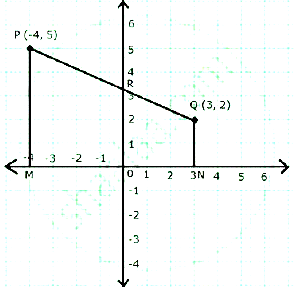
(i) Let point $R (0, y)$ divides $PQ$ in the ratio $k: 1.$
We have:
$x=\frac{k \times 3+1 \times(-4)}{k+1}$
$0=\frac{3 k-4}{k+1}$
$0=(3 k-4)$
$k=\frac{4}{3}$
thusPR $: R Q=4: 3$
(ii) Also, we have:
$y=\frac{k \times 2+1 \times 5}{k+1}$
$y=\frac{2 k+5}{k+1}$
$y=\frac{2 \times \frac{4}{3}+5}{\frac{4}{3}+1}$
$y=\frac{8+15}{4+3}$
$y=\frac{23}{7}$
Thus, the co-ordinates of point R are $\left(0, \frac{23}{7}\right)$
(iii) Area of quadrilateral PMNQ
$=\frac{1}{2} \times(P M+Q N) \times M N$
$=\frac{1}{2} \times(5+2) \times 7$
$=\frac{1}{2} \times 7 \times 7$
$=24.5 \text { sq.units }$ View full question & answer→Question 184 Marks
The line segment joining A $(4, 7)$ and B $(-6, -2)$ is intercepted by the y – axis at the point K. write down the abscissa of the point K. hence, find the ratio in which K divides AB. Also, find the co-ordinates of the point K.
AnswerSince, point K lies on y-axis, its abscissa is $0.$
Let the point K $(0, y)$ divides AB in the ratio $k : 1$
We have,
$x=\frac{k \times(-6)+1 \times 4}{k+1} $
$ 0=\frac{-6 k+4}{k+1} $
$ k=\frac{4}{6}=\frac{2}{3}$
Thus, K divides AB in the ratio $2: 3.$
Also, we have:
$y=\frac{k \times(-2)+1 \times 7}{k+1} $
$y=\frac{-2 k+7}{k+1}$
$ y=\frac{-2 \times \frac{2}{3}+7}{\frac{2}{3}+1}$
$ y=\frac{-4+21}{2+3} $
$y=\frac{17}{5}$
Thus, the co-ordinates of the point K are $\left(0, \frac{17}{5}\right)$
View full question & answer→Question 194 Marks
The line segment joining $A (2, 3)$ and $B (6, -5)$ is intercepted by $x-$ axis at the point $K.$ Write down the ordinate of the point $K.$ Hence, find the ratio inwhich $K$ divides $AB.$ Also find the coordinates of the point $K.$
AnswerSince, point $K$ lies on x-axis, its ordinate is $0.$
Let the point $K (x, 0)$ divides $AB$ in the ratio $k: 1.$
We have,
$y=\frac{k \times(-5)+1 \times 3}{k+1}$
$0=\frac{-5 k+3}{k+1}$
$k=\frac{3}{5}$
Thus, K divides AB in the ratio $3: 5.$
Also, we have:
$x=\frac{k \times 6+1 \times 2}{k+1}$
$x=\frac{\frac{3}{5} \times 6+2}{\frac{3}{5}+1}$
$x=\frac{18+10}{3+5}$
$x=\frac{28}{8}=\frac{7}{2}=3 \frac{1}{2}$
Thus, the co-ordinates of the point $K$ are $\left(3 \frac{1}{2}, 0\right)$
View full question & answer→Question 204 Marks
$A (2, 5), B (-1, 2)$ and $C (5, 8)$ are the co-ordinates of the vertices of the triangle $ABC.$ Points $P$
and $Q$ lie on $AB$ and $AC$ respectively,
Such that: $AP : PB = AQ : QC = 1 : 2$
(i) Calculate the co-ordinates of $P$ and $Q.$
(ii) Show that $PQ =1/3BC$
Answer(i) Co-ordinates of $P$ are
$\left(\frac{1 \times(-1)+2 \times 2}{1+2}, \frac{1 \times 2+2 \times 5}{1 \times 2}\right)$
$=\left(\frac{3}{3}, \frac{12}{3}\right)$
$=(1,4)$
Co-ordinates of Q are
$\left(\frac{1 \times 5+2 \times 2}{1+2}, \frac{1 \times 8+2 \times 5}{1+2}\right)$
$=\left(\frac{9}{3}, \frac{18}{3}\right)$
$=(3,6)$
(ii) Using distance formula, we have:
$B C=\sqrt{(5+1)^2+(8-2)^2}$
$B C=\sqrt{36+36}$
$B C=6 \sqrt{2}$
$P Q=\sqrt{(3-1)^2+(6-4)^2}$
$P Q=\sqrt{4+4}$
$P Q=2 \sqrt{2}$
Hence, $PQ=1/3Bc$
View full question & answer→Question 214 Marks
Show that $A (3, -2)$ is a point of trisection of the line segment joining the points $(2, 1)$ and $(5, -8).$
Also, find the co-ordinates of the other point of trisection.
AnswerLet $A$ and $B$ be the point of trisection of the line segment joining the points $P (2, 1)$ and $Q (5,−8).$
So, $PA = AB = BQ$
We have $PA : AQ = 1 : 2$
Co-ordinates of the point A are
$\left(\frac{1 \times 5+2 \times 2}{1+2}, \frac{1 \times(-8)+2 \times 1}{1+2}\right)$
$=\left(\frac{9}{3},-\frac{6}{3}\right)$
$=(3,-2)$
Hence, $A (3, −2)$ is a point of trisection of $PQ.$
We have $PB : BQ = 2 : 1$
Co-ordinates of the point $B$ are
$\left(\frac{2 \times 5+1 \times 2}{2+1}, \frac{2 \times(-8)+1 \times 1}{2+1}\right)$
$\left(\frac{10+2}{3}, \frac{-16+1}{3}\right)$
$=(4,-5)$
View full question & answer→Question 224 Marks
Show that the line segment joining the points $(-5, 8)$ and $(10, -4)$ is trisected by the co-ordinate axes.
Answer
Let $P$ and $Q$ be the point of trisection of the line segment joining the points $A (-5, 8)$ and $B (10, −4).$
So, $AP = PQ = QB$
We have $AP:PB = 1 : 2$
Co-ordinates of the point $P$ are
$\left(\frac{1 \times 10+2 \times(-5)}{2+1}, \frac{1 \times(-4)+2 \times 8}{1+2}\right)$
$=\left(\frac{10-10}{3}, \frac{12}{3}\right)$
$=(0,4)$
So, point $Q$ lies on the $x-$ axis.
Hence, the line segment joining the given points $A$ and $B$ is trisected by the co-ordinate axes
So, point $P$ lies on the y-axis
We have $AQ : QB = 2: 1$
Co-ordinates of the point $Q$ are
$\left(\frac{2 \times 10+1 \times(-5)}{2+1}, \frac{2 \times(-4)+1 \times 8}{1+2}\right)$
$=\left(\frac{20-5}{3}, \frac{-8+8}{3}\right)$
$=(5,0)$ View full question & answer→Question 234 Marks
Calculate the ratio in which the line joining the points $(-3, -1)$ and $(5, 7)$ is divided by the line $x = 2.$ Also, find the co-ordinates of the point of intersection.
AnswerThe co-ordinates of every point on the line $x = 2$ will be of the type $(2, y).$ Using section formula, we have:
$x=\frac{m_1 \times 5+m_2 \times(-3)}{m_1+m_2}$
$2=\frac{5 m_1-3 m_2}{m_1+m_2} $
$2 m_1+2 m_2=5 m_1=3 m_2 $
$ 5 m_2=3 m_1 $
$\frac{m_1}{m_2}=\frac{5}{3}$
Thus, the required ratio is 5: 3.
$y=\frac{m_1 \times 7+m_2 \times(-1)}{m_1+m_2} $
$ y=\frac{5 \times 7+3 \times(-1)}{5+3} $
$ y=\frac{35-3}{8} $
$ y=\frac{32}{8}$
$y=4$
Thus, the required co-ordinates of the point of intersection are $(2, 4).$
View full question & answer→Question 244 Marks
The points $(2, -1), (-1, 4)$ and $(-2, 2)$ are mid points of the sides of a triangle. Find its vertices
Answer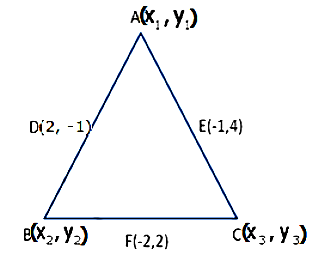
Let $A(x_1, y_1), B(x_2,y_2)$ and $C (x_3,y_3)$ be the coordinates of the vertices of $\triangle ABC.$
Midpoint of $AB,$ i.e. $D$
$D(2,-1)=D\left(\frac{x_1+x_2}{2}, \frac{y_1+y_2}{2}\right)$
$2=\frac{x_1+x_2}{2}, \frac{y_1+y_2}{2}=-1$
$x_1+x_2=4......(1)$
$y_1+y_2=-2.....(2)$
Similarly
$x_1+x_2=-2 .....(3)$
$y_1+y_3=8.....(4)$
$x_1+x_3=-4.....(5)$
$y_2+y_3=4 .....(6)$
Adding $(1), (3)$ and $(5),$ we get,
$2\left(x_1+x_2+x_3\right)=-2$
$x_1+x_2+x_3=-1$
$4+x_3=-1(\text { from(1)) }$
$x_3=-5$
from $(3)$
$x_1-5=-2$
$x_1=3$
From $(5)$
$x_2-5=-4$
$x_2=1$
Adding $(2), (4)$ and $(6),$ we get,
$2\left(y_1+y_2+y_3\right)=10$
$y_1+y_2+y_3=5$
$-2+y_3=5($ from $(2)$ $)$
$y_3=7$
From $(4)$
$y_1+7=8$
$y_1=1$
From $(6)$
$y_2+7=4$
$y_2=-3$
Thus, the co$-$ordinates of the vertices of $\triangle ABC$ are $(3,1), (1,-3)$ and $(-5,7)$ View full question & answer→Question 254 Marks
Given a line segment $AB$ joining the points $A (-4, 6)$ and $B (8, -3).$ Find:
$(i) $ the ratio in which $ AB$ is divided by the $y-$axis
$(ii)$ find the coordinates of the point of intersection
$(iii)$ the length of $AB.$
Answer$(i)$ Let the required ratio be $m_1 : m_2$
Consider $A(-4, 6) = (x_1, y_1); B(8, −3) = (x_2 , y_2)$ and let
$P(x, y)$ be the point of intersection of the line segment
And the $y-$axis
By section formula, we have,
$x=\frac{m_1 x_2+m_2 x_1}{m_1+m_2}, y=\frac{m_1 y_2+m_2 y_1}{m_1+m_2}$
$\Rightarrow x=\frac{8 m_1-4 m_2}{m_1+m_2}, y=\frac{-3 m_1+6 m_2}{m_1+m_2}$
The equation of the $y-$axis is $x = 0$
$\Rightarrow x=\frac{8 m_1-4 m_2}{m_1+m_2}=0$
$\Rightarrow 8 m_1-4 m_2=0$
$\Rightarrow 8 m_1=4 m_2$
$\Rightarrow \frac{m_1}{m_2}=\frac{4}{8}$
$\Rightarrow \frac{m_1}{m_2}=\frac{1}{2}$
$(ii)$ from the previous subpart, we have,
$\frac{m_1}{m_2}=\frac{1}{2}$
$\Rightarrow m_1=k$ and $m_2=2 k$, where $k$
Is any constant.
Also, we have,
$\Rightarrow x=\frac{8 m_1-4 m_2}{m_1+m_2}, y=\frac{-3 m_1+6 m_2}{m_1+m_2}$
$\Rightarrow x=\frac{8 k-4 \times 2 k}{k+2 k}, y=\frac{-3 k+6 \times 2 k}{k+2 k}$
$\Rightarrow x=\frac{8 k-8 k}{3 k}, y=\frac{-3 k+12 k}{3 k}$
$\Rightarrow x=\frac{0}{3 k}, y=\frac{9 k}{3 k}$
$\Rightarrow x=0, y=3$
Thus, the point of intersection is $p (0, 3)$
$(iii)$ The length of $AB =$ distance between two points $A $ and $B.$
The distance between two given points
$A\left(x_1, y_1\right)$ and $B \left(x_2, y_2\right)$ is given by,
$\text { Distance } AB =\sqrt{\left(x_2-x_1\right)^2+\left(y_2-y_1\right)^2}$
$=\sqrt{(8+4)^2+(-3-6)^2}$
$=\sqrt{12^2+9^2}$
$=\sqrt{144+81}$
$=\sqrt{225}$
$=15 \text { units }$
View full question & answer→