To double the length of a iron wire having $0.5\,c{m^2}$ area of cross-section, the required force will be $(Y = {10^{12}}\,dyne/c{m^2})$
Easy


Download our appand get started for free
Experience the future of education. Simply download our apps or reach out to us for more information. Let's shape the future of learning together!No signup needed.*
Similar Questions
- 1A wire of length $L$ and radius $r$ is clamped rigidly at one end. When the other end of the wire is pulled by a force $F$, its length increases by $5\,cm$. Another wire of the same material of length $4 L$ and radius $4\,r$ is pulled by a force $4\,F$ under same conditions. The increase in length of this wire is $....cm$.View Solution
- 2View SolutionThe possible value of Poisson's ratio is
- 3If Young's modulus of iron is $2 \times {10^{11}}\,N/{m^2}$ and the interatomic spacing between two molecules is $3 \times {10^{ - 10}}$metre, the interatomic force constant is ......... $N/m$View Solution
- 4View SolutionA light rod acted upon by three forces, is in equilibrium. Which of the following diagram shows the possible position and direction of the forces?
- 5The ratio of diameters of two wires of same material is $n : 1$. The length of wires are $4\, m$ each. On applying the same load, the increase in length of thin wire will beView Solution
- 6For a given material, the Young's modulus is $2.4$ times that of rigidity modulus. Its Poisson's ratio isView Solution
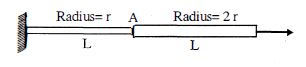
- 7Two steel wires of same length but radii $r$ and $2r$ are connected together end to end and tied to a wall as shown. The force stretches the combination by $10\ mm$ . How far does the midpoint $A$ move ......... $mm$View Solution
- 8In a series combination of copper and steel wires of same length and same diameter, a force is applied at one of their ends while the other end is kept fixed. The combined length is increased by $2\, cm$. The wires will have ..........View Solution
- 9Four identical hollow cylindrical columns of mild steel support a big structure of mass $50 \times 10^{3} {kg}$, The inner and outer radii of each column are $50\; {cm}$ and $100 \;{cm}$ respectively. Assuming uniform local distribution, calculate the compression strain of each column. [Use $\left.{Y}=2.0 \times 10^{11} \;{Pa}, {g}=9.8\; {m} / {s}^{2}\right]$View Solution
- 10The pressure that has to be applied to the ends of a steel wire of length $10\ cm$ to keep its length constant when its temperature is raised by $100^o C$ is: (For steel Young's modulus is $2 \times 10^{11}$ $Nm^{-1}$ and coefficient of thermal expansion is $1.1 \times 10^{-5}$ $K^{-1}$ )View Solution