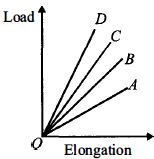
The load versus elongation graphs for four wires of same length and made of the same material are shown in the figure. The thinnest wire is represented by the line
AIEEE 2012, Medium


Download our appand get started for free
Experience the future of education. Simply download our apps or reach out to us for more information. Let's shape the future of learning together!No signup needed.*
Similar Questions
- 1The increase in length on stretching a wire is $0.05\%$. If its Poisson's ratio is $0.4$, then its diameterView Solution
- 2If a spring is extended to length $l,$ then according to Hook's lawView Solution
- 3If Poission's ratio $\sigma $ is $ - \frac{1}{2}$ for a material, then the material isView Solution
- 4Two separate wires $A$ and $B$ are stretched by $2 \,mm$ and $4\, mm$ respectively, when they are subjected to a force of $2\, N$. Assume that both the wires are made up of same material and the radius of wire $B$ is 4 times that of the radius of wire $A$. The length of the wires $A$ and $B$ are in the ratio of $a : b$. Then $a / b$ can be expressed as $1 / x$ where $x$ isView Solution
- 5View SolutionWhich of the following relations is true
- 6What is the percentage increase in length of a wire of diameter $2.5 \,mm$, stretched by a force of $100 \,kg$ wt is .................. $\%$ ( Young's modulus of elasticity of wire $=12.5 \times 10^{11} \,dyne / cm ^2$ )View Solution
- 7View SolutionIn solids, inter-atomic forces are
- 8The Young's modulus of a steel wire of length $6\,m$ and cross-sectional area $3\,mm ^2$, is $2 \times 11^{11}\,N / m ^2$. The wire is suspended from its support on a given planet. A block of mass $4\,kg$ is attached to the free end of the wire. The acceleration due to gravity on the planet is $\frac{1}{4}$ of its value on the earth. The elongation of wire is (Take $g$ on the earth $=10$ $\left.m / s ^2\right):$View Solution
- 9Join the relation of physical quantities in Column$-I$ to the details given in Column$-II$ appropriately :View Solution
Column $-I$ Column $-II$ $(a)$ Stress $\propto $ Strain $(i)$ $M^1\,L^{-1}\,T^{-2}$ $(b)$ Dimensional formula for compressibility $(ii)$ $M^{-1}\,L^{1}\,T^{-2}$ $(iii)$ Poisson’s ratio $(iv)$ Hooke’s law - 10View SolutionWhich of the following relations is true