MCQ
The locus of  a point equidistant from two given points $ a$  and $ b $ is given by
  • $[r - \frac{1}{2}(a + b)]\,.\,\,(a - b) = 0$
  • B
    $[r - \frac{1}{2}(a - b)]\,.\,\,(a + b) = 0$
  • C
    $[r - \frac{1}{2}(a + b)].(a + b) = 0$
  • D
    $[r - \frac{1}{2}(a - b)]\,.\,\,(a - b) = 0$
Answer

Correct option: A.
$[r - \frac{1}{2}(a + b)]\,.\,\,(a - b) = 0$
a
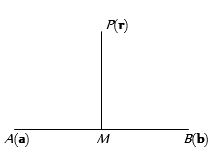
(a) Let $P(r)$ be equidistant from $A\,\,(a)$ and $B\,\,(b)$ and $PM$ be perpendicular to $AB.$

Then $M$ is the mid point of $AB.$

$\therefore $ Position vector of $M$ is $\frac{1}{2}(a + b).$

$\overrightarrow {PM} \,.\,\overrightarrow {BA} = 0$ or $\left[ {r - \frac{1}{2}(a + b)} \right]\,.\,(a - b) = 0.$

Need a full question paper?

Generate a complete, print-ready paper with questions like this in minutes — across 16+ boards, with answer keys.

Start Generating Free

Similar questions

Choose the correct answer from the given four options. Suppose a random variable $X$ follows the binomial distribution with parameters $n$ and $p,$ where $0 < p < 1.$ If $\frac{\text{P}(\text{x}=\text{r})}{\text{P}(\text{x}=\text{n}–\text{r})}$ is independent of $n$ and $r,$ then $p$ equals :
Let $f :R \to R$ be a function defined as $f\left( x \right) = \left\{ \begin{array}{l}
5,\,\,\,\,\,\,\,\,\,\,\,\,\,\,\,if\,\,\,\,\,\,\,x \le 1\,\,\,\,\,\,\,\\
a + bx,\,\,\,\,if\,\,\,\,\,\,1 < x < 3\\
b + 5x,\,\,\,\,if\,\,\,\,\,\,3 \le x < 5\\
30,\,\,\,\,\,\,\,\,\,\,if\,\,\,\,\,\,\,x \ge 5
\end{array} \right.\,\,\,\,$ Then $f$ is
Let $\vec a = 2\hat i + \hat j - 2\hat k,\vec b = \hat i + \hat j$. If $\vec c$ is a vector such that $\vec a.\vec c = \left| {\vec c} \right|,\left| {\vec c - \vec a} \right| = 2\sqrt 2 $ and the angle between $\vec a \times \vec b$ and $\vec c$ is $30^o$, then $\left| {\left( {\vec a \times \vec b} \right) \times \vec c} \right|$ equals 
If $\vec{b}$ and $\vec{c}$ are any two non-collinear unit vectors and $\vec{a}$ is any vector, then find the value of $(\vec{a} \cdot \vec{b}) \vec{b}+(\vec{a} \cdot \vec{c}) \vec{c}+\frac{\vec{a} \cdot(\vec{b} \times \vec{c})}{|\vec{b} \times \vec{c}|} \cdot(\vec{b} \times \vec{c})$.
$\smallint \frac{{{{\sin }^2}x{{\cos }^2}x}}{{{{\left( {{{\sin }^5}x + {{\cos }^3}x{{\sin }^2}x + {{\sin }^3}x{{\cos }^2}x + {{\cos }^5}x} \right)}^2}}}dx$
If $y = x + {1 \over x}$, then
The sum of the order and degree of the differential equation $1+\left(\frac{d y}{d x}\right)^4=7\left(\frac{d^2 y}{d x^2}\right)^3$ is
Let $\lambda^{*}$ be the largest value of $\lambda$ for which the function $f _{\lambda}( x )=4 \lambda x ^{3}-36 \lambda x ^{2}+36 x +48$ is increasing for all $x \in R$. Then $f _{\lambda} *(1)+ f _{\lambda} *(-1)$ is equal to 
Given vectors $a, b, c $ such that $a\,.(b \times c)$$ = \lambda \ne 0,\,$ the value of $(b \times c)\,.\,(a + b + c)/\lambda $ is
If $A=\left[\tan \left(\frac{\theta}{2}\right)^{-\tan \left(\frac{\theta}{2}\right)}{0}\right]$ and $\left( I _{2}+ A \right)\left( I _{2}- A \right)^{-1}=\left[\begin{array}{ll} a & - b \\ b & a \end{array}\right],$ then $13\left( a ^{2}+ b ^{2}\right)$ is equal to ...........