MCQ
The locus of the centroid of the triangle formed by any point $\mathrm{P}$ on the hyperbola $16 \mathrm{x}^{2}-9 \mathrm{y}^{2}+$ $32 x+36 y-164=0$, and its foci is:
  • A
    $9 x^{2}-16 y^{2}+36 x+32 y-36=0$
  • $16 x^{2}-9 y^{2}+32 x+36 y-36=0$
  • C
    $16 x^{2}-9 y^{2}+32 x+36 y-144=0$
  • D
    $9 x^{2}-16 y^{2}+36 x+32 y-144=0$

Answer

Correct option: B.
$16 x^{2}-9 y^{2}+32 x+36 y-36=0$
b
Given hyperbola is

$16(x+1)^{2}-9(y-2)^{2}=164+16-36=144$

$\Rightarrow \frac{(x+1)^{2}}{9}-\frac{(y-2)^{2}}{16}=1$

$\text { Eccentricity, } e=\sqrt{1+\frac{16}{9}}=\frac{5}{3}$

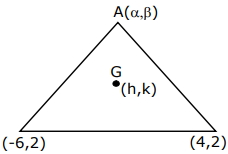
$\Rightarrow \text { foci are }(4,2) \text { and }(-6,2)$

Let the centroic be $(\mathrm{h}, \mathrm{k})$

$\, A(\alpha, \beta)$ be point on hyperbola

So $h=\frac{\alpha-6+4}{3}, k=\frac{\beta+2+2}{3}$

$\Rightarrow \alpha=3 h+2, \beta=3 k-4$

$(\alpha, \beta)$ lies on hyperbola so

$16(3 h+2+1)^{2}-9(3 k-4-2)^{2}=144$

$\Rightarrow 144(h+1)^{2}-81(k-2)^{2}=144$

$\Rightarrow 16\left(h^{2}+2 h+1\right)-9\left(k^{2}-4 k+4\right)=16$

$\Rightarrow 16 x^{2}-9 y^{2}+32 x+36 y-36=0$
Need a full question paper?

Generate a complete, print-ready paper with questions like this in minutes — across 16+ boards, with answer keys.

Start Generating Free

Similar questions

A box contains $3$ white and $2$ red balls. A ball is drawn and another ball is drawn without replacing first ball, then the probability of second ball to be red is
In the first 10 overs of a cricket game, the run rate was only 3.2 What should be the run rate in the remaining 40 overs to reach the target of 282 runs?
There are $15$ terms in an arithmetic progression. Its first term is $5$ and their sum is $390$. The middle term is
If $z=\frac{1}{2}-2 i$, is such that $|z+1|=\alpha z+\beta(1+i), i=\sqrt{-1}$ and $\alpha, \beta \in R \quad$, then $\alpha+\beta$ is equal to
If both roots of quadratic equation ${x^2} + \left( {\sin \,\theta  + \cos \,\theta } \right)x + \frac{3}{8} = 0$ are positive and distinct then complete set of values of $\theta $ in $\left[ {0,2\pi } \right]$ is 
Let A and B be two sets such that A ∩ B = ϕ. Find the value of (A ∪ B′) =
The number of permutations of the letters $a_1, a_2, a_3, a_4, a_5$ in which the first letter $a_1$ does not occupy the first position (from the left) and the second letter $a_2$ does not occupy the second position (from the left) is
$x - 2 = {t^2},\;y = 2t$ are the parametric equations of the parabola
If $\alpha$ denotes the number of solutions of $|1-i|^x=2^x$ and $\beta=\left(\frac{|z|}{\arg (z)}\right)$, where $z=\frac{\pi}{4}(1+i)^4\left(\frac{1-\sqrt{\pi i}}{\sqrt{\pi}+i}+\frac{\sqrt{\pi}-i}{1+\sqrt{\pi} \mathrm{i}}\right), i=\sqrt{-1}$, then the distance of the point $(\alpha, \beta)$ from the line $4 x-3 y=7$ is
For a real number $r$ we denote by $[r]$ the largest integer less than or equal to $r$. If $x, y$ are real numbers with $x, y \geq 1$ then which of the following statements is always true?