Question
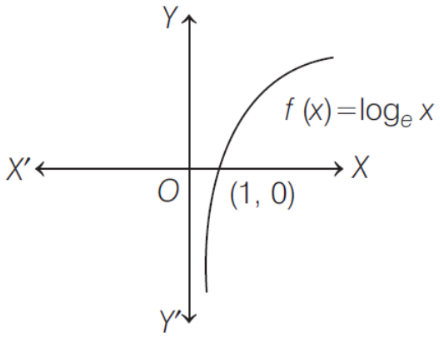
The logarithmic function expressed as $\log _e R^{+} \rightarrow R$ and given by $\log _e x=y$ iff $e^y=x$. The graph of the function is given below :
Image
(i) Domain of $f(x)=(0, \infty)$ or $R^{+}$
(ii) Range of $f(x)=(-\infty, \infty)$ or $R$

To find the limit of functions involving logarithmic function, we use the following theorem Theorem $\lim _{x \rightarrow 0} \frac{\log _e(1+x)}{x}=1$

Based on above information, answer the following questions.

(i) $\lim _{x \rightarrow 0} \frac{\log _e(1+5 x)}{x}$ is equal to
    (a) 5     (b) 4     (c) 3     (d) 1

(ii) $\lim _{x \rightarrow 0} \frac{\log _e(1+6 x)-5 x^2}{x}$ is equal to
    (a) 1     (b) 2     (c) 3     (d) 6

(iii) $\quad \lim _{x \rightarrow 0} \frac{\sqrt{1+x}-1}{\log (1+x)}$ is equal to
    (a) 1     (b) $\frac{1}{2}$     (c) $\frac{1}{3}$     (d) $\frac{3}{2}$

(iv) $\quad \lim _{x \rightarrow 5} \frac{\log x-\log 5}{x-5}$ is equal to
    (a) $\frac{1}{5}$     (b) $\frac{3}{5}$     (c) $\frac{1}{4}$     (d) $\frac{2}{3}$

(v) $\quad \lim _{x \rightarrow 0} \frac{\log (5+x)-\log (5-x)}{x}$ is equal to
    (a) $\frac{1}{5}$     (b) $\frac{2}{5}$     (c) $\frac{3}{5}$     (d) $\frac{4}{5}$
Answer

(i)
We have, $\lim _{x \rightarrow 0} \frac{\log _e(1+5 x)}{x}$
$
\begin{aligned}
& =5 \lim _{5 x \rightarrow 0} \frac{\log _e(1+5 x)}{5 x}=5 \times 1=5 \\
& {[\because x \rightarrow 0 \Rightarrow 5 x \rightarrow 0]}
\end{aligned}
$

(ii)
We have, $\lim _{x \rightarrow 0} \frac{\log _{\ell}(1+6 x)-5 x^2}{x}$
$
\begin{aligned}
& =6 \lim _{6 x \rightarrow 0} \frac{\log _e(1+6 x)}{6 x}-5 \lim _{x \rightarrow 0} x \\
& {[\because x \rightarrow 0 \Rightarrow 6 x \rightarrow 0]} \\
& =6 \times(1)-5 \times(0)=6
\end{aligned}
$

(iii)
$
\lim _{x \rightarrow 0} \frac{\sqrt{1+x}-1}{\log (1+x)}
$
On multiplying numerator and denominator by $\sqrt{1+x}+1$, we get

$\begin{aligned} \lim _{x \rightarrow 0} & \frac{\sqrt{1+x}-1}{\log (1+x)} \times \frac{\sqrt{1+x}+1}{(\sqrt{1+x}+1)} \\ & =\lim _{x \rightarrow 0} \frac{1+x-1}{(\sqrt{1+x}+1) \log (1+x)} \\ & =\lim _{x \rightarrow 0} \frac{x}{(\sqrt{1+x}+1) \log (1+x)} \\ & =\frac{1}{(\sqrt{1+0}+1)} \lim _{x \rightarrow 0} \frac{1}{\frac{\log (1+x)}{x}} \\ & =\frac{1}{1+1} \times \frac{1}{\lim _{x \rightarrow 0} \frac{\log (1+x)}{x}} \\ & =\frac{1}{1+1} \times 1=\frac{1}{2}\end{aligned}$

(iv)
Put $x-5=h$ and as $x \rightarrow 5$, then $h \rightarrow 0$
$
\begin{aligned}
& \therefore \lim _{h \rightarrow 0} \frac{\log (h+5)-\log 5}{h} \\
& =\lim _{\frac{h}{5} 0} \frac{\log \left(1+\frac{h}{5}\right)}{\frac{h}{5} \times 5}=\frac{1}{5} \\
& {\left[\begin{array}{rl}
\because \log m-\log n & =\log \frac{m}{n}, \\
h \rightarrow 0 & \Rightarrow \frac{h}{5} \rightarrow 0
\end{array}\right]} \\
&
\end{aligned}
$

(v)
$
\begin{gathered}
\lim _{x \rightarrow 0} \frac{\log \left\{5\left(1+\frac{x}{5}\right)\right\}-\log \left\{5\left(1-\frac{x}{5}\right)\right\}}{x} \\
=\lim _{x \rightarrow 0} \frac{\left\{\log 5+\log \left(1+\frac{x}{5}\right)\right\}-\left\{\log 5+\log \left(1-\frac{x}{5}\right)\right\}}{x} \\
=\lim _{\frac{x}{5} \rightarrow 0} \frac{1}{5} \frac{\log \left(1+\frac{x}{5}\right)}{\frac{x}{5}}-\lim _{\frac{x}{5} \rightarrow 0} \frac{\log \left(1-\frac{x}{5}\right)}{-\frac{x}{5}} \cdot \frac{1}{(-5)}
\end{gathered}
$
$\begin{aligned} & {\left[\because x \rightarrow 0 \Rightarrow \frac{x}{5} \rightarrow 0\right]} \\ & =\frac{1}{5} \times(1)+\frac{1}{5} \times(1)=\frac{2}{5}\end{aligned}$

Need a full question paper?

Generate a complete, print-ready paper with questions like this in minutes — across 16+ boards, with answer keys.

Start Generating Free

Similar questions

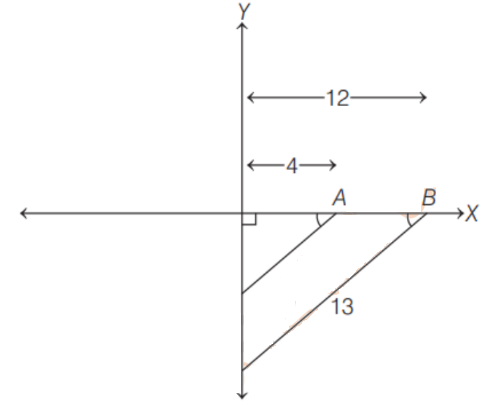
Rajiv constructs two right angled triangles in the fourth quadrant in such a way that the measure of triangle gives $\cos A=\frac{4}{5}$ and $\cos B=\frac{12}{13}$, where $\frac{3 \pi}{2} < A$ and $B > 2 \pi$.
Image
Based on the above information, answer the following questions.
(i) Find the value of $\cos (A+B)$
(ii) Find the value of $\sin (A-B)$
(iii) Find the value of $\tan (\mathbf{A}+\mathbf{B})$
In an University, out of 100 students 15 students offered Mathematics only, 12 students offered Statistics only, 8 students offered only Physics, 40 students offered Physics and Mathematics, 20 students offered Physics and Statistics, 10 students offered Mathematics and Statistics, 65 students offered Physics.
Based on the above information answer the following questions.
  1. The number of students who offered all the three subjects is:
  1. 4
  2. 3
  3. 2
  4. 5
  1. The number of students who offered Mathematics is:
  1. 62
  2. 65
  3. 55
  4. 60
  1. The number of students who offered statistics is:
  1. 31
  2. 35
  3. 39
  4. 34
  1. The number of students who offered mathematics and statistics but not physics is:
  1. 7
  2. 6
  3. 5
  4. 4
  1. The number of students who did not offer any of the above three subjects is:
  1. 4
  2. 1
  3. 5
  4. 3
Read the following text carefully and answer the questions that follow: Representation of a Relation
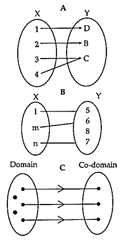
A relation can be represented algebraically by roster form or by set-builder form and visually it can be represented by an arrow diagram which are given below
i. Roster form In this form, we represent the relation by the set of all ordered pairs belongs to R.
ii. Set-builder form In this form, we represent the relation $R$ from set $A$ to set $B$ as $R=\{(a, b): a \in A, b \in B$ and the rule which relate the elements of A and B \}.
iii. Arrow diagram To represent a relation by an arrow diagram, we draw arrows from first element to second element of all ordered pairs belonging to relation R. 
Questions
i. If n(A) = 3 and B = {2, 3, 4, 6, 7, 8} then find the number of relations from A to B. (1)
ii. If A = {a, b} and B = {2, 3}, then find the number of relations from A to B. (1)
iii. If A = {a, b} and B = {2, 3}, write the relation in set-builder form. (2) 
OR
Express of $R =\{( a , b ): 2 a + b =5 ; a , b \in W \}$ as the set of ordered pairs (in roster form). (2)
Read the following text carefully and answer the questions that follow: 
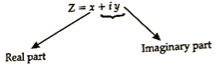
A number of the form $Z=x+i y$, where $x$ and $y$ are real and $i=\sqrt{-1}$ is called a complex number. Consider the complex number $Z_1=2+3 i$ and $Z_2=4-3 i$.
Image
i. Find the imaginary part of $Z_1 \overline{Z_1}$. (1)
ii. Find the real part of $\frac{z_1}{z_2}$. (1)
iii. Find the imaginary part of $Z_1-Z_2$. (2)
OR
Find the real part of $Z _1$. (2)