MCQ
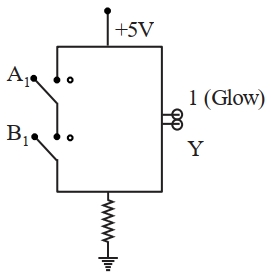
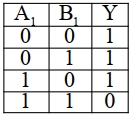
The logic gate equivalent to the given circuit diagram is:
  • A
    $OR$
  • $NAND$
  • C
    $NOR$
  • D
    $AND$

Answer

Correct option: B.
$NAND$
b
$Y =\overline{ A _1 \odot B _1}\,\,\,\,NAND$

Need a full question paper?

Generate a complete, print-ready paper with questions like this in minutes — across 16+ boards, with answer keys.
Start Generating Free

Similar questions

What should be the maximum acceptance angle at the air-core interface of an optical  fibre if $n_1$ and $n_2$ are the refractive indices of the core and the cladding  respectively
In old age arteries carrying blood in the human body become narrow resulting in an increase in the blood pressure. This follows from
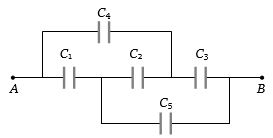
In the given figure the capacitors ${C_1},{C_3},{C_4},{C_5}$ have a capacitance $4\,\mu F$ each if the capacitor $C_2$ has a capacitance $10\,F$, then effective capacitance between $A$ and $B$ will be.....$\mu F$
A $2\,kg$ copper block is heated to $500^o\,C$ and then it is placed on a large block of ice  at $0^o\,C$. If the specific heat capacity of copper is $400\, J/kg/ ^o\,C$ and latent heat of  fusion of water is $3.5 \times 10^5\, J/kg$, the amount of ice, that can melt is :-
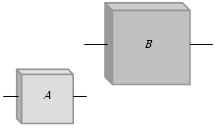
$A$ and $B$ are two square plates of same metal and same thickness but length of $B$ is twice that of $A$. Ratio of resistances of $A$ and $B$ is
Consider two masses with $m_1 > m_2$ connected by a light inextensible string that passes over a pulley of radius $R$ and moment of inertia $I$ about its axis of rotation. The string does not slip on the pulley and  the pulley turns without friction. The two masses are released from rest separated by a vertical distance $2 h$. When the two masses pass each other, the speed of the masses is proportional to
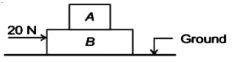
Blocks shown in figure moves with constant velocity $10 \,m / s$ towards right. All surfaces in contact are rough. The friction force applied by $B$ on $A$ is ...........$N$
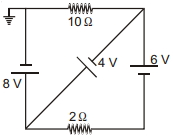
In the circuit shown in figure, all cells are ideal. The current through $2 \,\Omega$ resistor is ............ $A$
The figure shows a velocity-time graph of a particle moving along a straight line  The correct displacement-time graph of the particle is shown as
Which of the following statement is false for the properties of electromagnetic waves ?