In old age arteries carrying blood in the human body become narrow resulting in an increase in the blood pressure. This follows from
AIIMS 2004, Easy
Download our app for free and get started
In old age arteries carrying blood when there in narrow arteries pressure is increased. Actually due to narrowness and other obstruction the velocity of the flow of blood gets decreased. This results in increased pressure inside the blood vessel, according to Bernoulli’s principle.

Download our appand get started for free
Experience the future of education. Simply download our apps or reach out to us for more information. Let's shape the future of learning together!No signup needed.*
Similar Questions
- 1Some liquid is filled in a cylindrical vessel of radius $R$. Let $ F_1 $ be the force applied by the liquid on the bottom of the cylinder. Now the same liquid is poured into a vessel of uniform square crss-section of side $R$. Let $F_2$ be the force applied by the liquid on the bottom of this new vessel. Then:View Solution
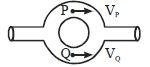
- 2In the figure shown, a liquid is flowing through a tube at the rate of $0.1\, m^3/sec$. The tube is branched into two semicircular tubes of cross-sectional area $A/3$ and $2A/3$. The velocity of liquid at $Q$ is ......... $ m/sec$ (The cross-section of the main tube $= A =10^{-2}\, m^2$ and $v_p = 20\, m/sec$)View Solution
- 3A metallic sphere weighing $3 \,kg$ in air is held by a string so as to be completely immersed in a liquid of relative density $0.8$. The relative density of metallic is $10$. The tension in the string is ........ $N$View Solution
- 4The terminal velocity of a small sphere of radius $a$ in a viscous liquid is proportional toView Solution
- 5The rate of steady volume flow of water through a capillary tube of length $ 'l' $ and radius $ 'r' $ under a pressure difference of $P$ is $V$. This tube is connected with another tube of the same length but half the radius in series. Then the rate of steady volume flow through them is (The pressure difference across the combination is $ P$)View Solution
- 6A spring balance reads $200 \,gF$ when carrying a lump of lead in air. If the lead is now immersed with half of its volume in brine solution, what will be the new reading of the spring balance? specific gravity of lead and brine are $11.4$ and $1.1$ respectively ........... $gF$View Solution
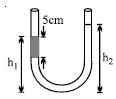
- 7An open-ended $U$-tube of uniform cross-sectional area contains water (density $1.0 $ gram/centimeter$^3$) standing initially $20$ centimeters from the bottom in each arm. An immiscible liquid of density $4.0$ grams/ centimeter $^3$ is added to one arm until a layer $5$ centimeters high forms, as shown in the figure above. What is the ratio $h_2/h_1$ of the heights of the liquid in the two arms?View Solution
- 8A water drop of radius $1\,\mu m$ falls in a situation where the effect of buoyant force is negligible. Coefficient of viscosity of air is $1.8 \times 10^{-5}\,Nsm ^{-2}$ and its density is negligible as compared to that of water $10^{6}\,gm ^{-3}$. Terminal velocity of the water drop is________ $\times 10^{-6}\,ms ^{-1}$View Solution
(Take acceleration due to gravity $=10\,ms ^{-2}$ )
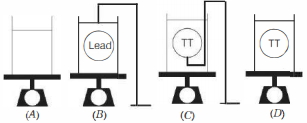
- 9Four identical beakers contain same amount of water as shown below. Beaker $A$ contains only water. A lead ball is held submerged in the beaker $B$ by string from above. A same sized plastic ball, say a table tennis $(TT)$ ball, is held submerged in beaker $C$ by a string attached to a stand from outside. Beaker $D$ contains same sized $TT$ ball which is held submerged from a string attached to the bottom of the beaker. These beakers (without stand) are placed on weighing pans and register readings $w_{A}, w_{B}, w_{C}$ and $w_{D}$ for $A, B, C$ and $D$, respectively. Effects of the mass and volume of the stand and string are to be neglected.View Solution
- 10A water tank of height $10\,m$, completely filled with water is placed on a level ground. It has two holes one at $3\, m$ and the other at $7\, m$ from its base. The water ejecting fromView Solution