MCQ
The longitudinal strain is only possible in
  • A
    Gases
  • B
    Fluids
  • Solids
  • D
    Liquids

Answer

Correct option: C.
Solids
c
(c)

Need a full question paper?

Generate a complete, print-ready paper with questions like this in minutes — across 16+ boards, with answer keys.
Start Generating Free

Similar questions

A spherical body of mass $100 \mathrm{~g}$ is dropped from a height of $10 \mathrm{~m}$ from the ground. After hitting the ground, the body rebounds to a height of $5 \mathrm{~m}$. The impulse of force imparted by the ground to the body is given by : (given $\mathrm{g}=9.8 \mathrm{~m} / \mathrm{s}^2$ )
If a body $A$ of mass $M$ is thrown with velocity $v$ at an angle of ${30^o}$ to the horizontal and another body $B$ of the same mass is thrown with the same speed at an angle of ${60^o}$ to the horizontal. The ratio of horizontal range of $A$ to $B$ will be
A $2\, m$ long rod of radius $1\, cm$ which is fixed from one end is given a twist of $0.8$ radians. The shear strain developed will be
An air bubble of $1\, cm$ radius is rising at a steady rate of $2.00\, mm/sec$ through a liquid of density $1.5\, gm$ per $cm^3$. Neglect density of air. If $g$ is $1000\, cm/sec^2$, then the coefficient of viscosity of the liquid is
A hot and a cold body are kept in vacuum separated from each other. Which of the following causes decrease in temperature of the hot body?
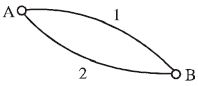
A small body slips, subject to the force of friction, from point $A$ to point $B$ along two curved surfaces of equal radius, first along route $1,$ then along route $2$. Friction does not depend on the speed and the coefficient of friction on both routes is the same. In which case will the body’s speed at $B$ be greater?
Variation of the density of water with respect to temperature from $0^\circ C$ to $10^\circ C$ is correctly represented by:
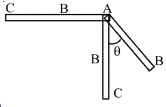
$A$ rod hinged at one end is released from the horizontal position as shown in the figure. When it becomes vertical its lower half separates without exerting any reaction at the breaking point. Then the maximum angle $‘\theta ’$ made by the hinged upper half with the vertical is ......... $^o$.
The random error in the arithmetic mean of $100$ observations is $x$; then random error in the arithmetic mean of $400$ observations would be
Dimensional formula for thermal conductivity is (here $K$ denotes the temperature)