Question
The magnet can be completely demagnetized by(a) Breaking the magnet into small pieces(b) Heating it slightly(c) Droping it into ice cold water(d) A reverse field of appropriate strength


Answer

(d) A reverse field of appropriate strength

Need a full question paper?

Generate a complete, print-ready paper with questions like this in minutes — across 16+ boards, with answer keys.
Start Generating Free

Similar questions

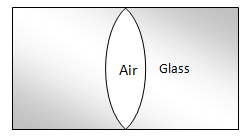
In the figure, an air lens of radii of curvature $10 \ cm (\mathrm{R}_1=\mathrm{R}_2= 10 \ cm)$ is cut in a cylinder of glass $(\mu = 1.5).$ The focal length and the nature of the lens is
The dipole moment of each molecule of a paramagnetic gas is $1.5 \times 10^{-23} \ \mathrm{amp} \times \mathrm{m}^2$. The temperature of gas is $27^{\circ} \mathrm{C}$ and the number of molecules per unit volume in it is $2 \times 10^{26} \mathrm{~m}^{-3}$. The maximum possible intensity of magnetisation in the gas will be
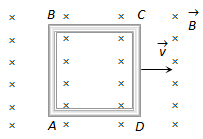
A conducting square loop of side $L$ and resistance $R$ moves in its plane with a uniform velocity $v$ perpendicular to one of its sides. A magnetic induction $B$ constant in time and space, pointing perpendicular and into the plane of the loop exists everywhere. The current induced in the loop is
Assertion :   Electric conduction in gases is possible at normal pressure.
Reason     : The electric conduction in gases depends only upon the potential difference between the electrodes.(a) If both assertion and reason are true and the reason is the correct explanation of the assertion.(b) If both assertion and reason are true but reason is not the correct explanation of the assertion.(c) If assertion is true but reason is false.(d) If the assertion and reason both are false.


The material of wire of potentiometer is(a) Copper(b) Steel(c) Manganin(d) Aluminium
       
Critical angle for light going from medium (i) to (ii) is q. The speed of light in medium (i) is v then speed in medium (ii) is(a) v(1- cosθ)(b) v/sinθ(c) v/cosθ(d) v(1- sinθ)
       
Two particles $X$ and $Y$ having equal charges, after being accelerated through the same potential difference, enter a region of uniform magnetic field and describe circular paths of radii $R_1$ and $R_2$ respectively. The ratio of masses of $X$ to that of $Y$ is:
The equivalent capacitance of three capacitors of capacitance $C_1, C_2$ and $C_3$ are connected in parallel is $12$ units and product $C_1 \cdot C_2 \cdot C_3=48$. When the capacitors $C_1$ and $C_2$ are connected in parallel, the equivalent capacitance is $6$ units. Then the capacitance are
For the myopic eye, the defect is cured by 
(a) Convex lens(b) Concave lens (c) Cylindrical lens(d) Toric lens 
       
Identify the type of conductors in which both positive and negative charges can move.