MCQ
The magnetic lines of force inside a bar magnet
  • Are from south-pole to north-pole of the magnet
  • B
    Are from north-pole to south-pole of the magnet
  • C
    Do not exist
  • D
    Depend upon the area of cross-section of the bar magnet

Answer

Correct option: A.
Are from south-pole to north-pole of the magnet
a
(a) The magnetic lines of force inside a bar magnet are from south pole to north pole of the magnet.

Need a full question paper?

Generate a complete, print-ready paper with questions like this in minutes — across 16+ boards, with answer keys.
Start Generating Free

Similar questions

If velocity $[V],$ time $[T]$ and force $[F]$ are chosen as the base quantities, the dimensions of the mass will be
The ratio of the magnitude of the magnetic field and electric field intensity of a plane electromagnetic wave in free space of permeability $\mu_0$ and permittivity $\varepsilon_0$ is (Given that $c$ - velocity of light in free space)
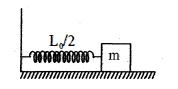
A block of mass $m$ is pushed against a spring whose spring constant is $k$ fixed at one end with a wall. The block can slide on a frictionless table as shown in figure. If the natural length of spring is $L_0$ and it is compressed to half its length when the block is released, find the velocity of the block, when the spring has natural length
The intensity level due to two waves of the same frequency in a given medium are $1\, bel$ and $5\, bel$. Then the ratio of amplitudes is
One mole of monoatomic gas and three moles of diatomic gas are put together in a container. The molar specific heat (in $J\,{K^{ - 1}}\,mo{l^{ - 1}})$ at constant volume is $(R = 8.3\,J\,{K^{ - 1}}\,mo{l^{ - 1}})$
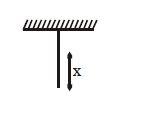
A wire of variable mass per unit length $\mu = \mu _0x$ , is hanging from the ceiling as shown in figure. The length of wire is $l_0$ . A small transverse disturbance is produced at its lower end. Find the time after which the disturbance will reach to the other ends
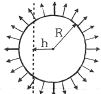
Consider a metal sphere of radius $R$ that is cut in two parts along a plane whose minimum distance from the sphere's centre is $h$. Sphere is uniformly charged by a total electric charge $Q$. The minimum force necessary to hold the two parts of the sphere together, is
Two light wave of intensities $I_0$ and $9I_0$ superpose at a point to produce a resultant intensity of $7I_0$. Calculate phase difference between light waves
If $| A + B |=| A |+| B |$ the angle between $\overrightarrow A $and $\overrightarrow B$ is $...... ^\circ$
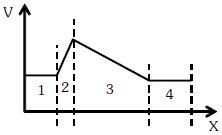
In which region magnitude of $x$ -component of electric field is maximum, if potential $(V)$ versus distance $(X)$, graph is as shown?