MCQ
The magnetic materials having negative magnetic susceptibility are:
- ANon-magnetic.
- BPara magnetic.
- CDia magnetic.
- DFerro magnetic.
Explanation:
Magnetic susceptibility is a dimensionless proportionality constant that indicates the degree of magnetisation of a material in response to an applied magnetic field.
Substances such as copper, iron have negative susceptibility as these substances are diamagnetic substances.
Substances with negative susceptibility signifies that they are repelled by magnets.
Generate a complete, print-ready paper with questions like this in minutes — across 16+ boards, with answer keys.
If the kinetic energy of a free electron doubles, its de-Broglie wavelength changes by the factor
|
(a) |
(b) |
(c) |
(d) 2 |
A particle A has charge +q and a particle B has charge +4q with each of them having the same mass m. When allowed to fall from rest through the same electric potential difference, the ratio of their speed  will become
|
(a) 2 : 1 |
(b) 1 : 2 |
(c) 1 : 4 |
(d) 4 : 1 |
The binding energies per nucleon for a deuteron and an α- particle are x1 and x2 respectively. What will be the energy Q released in the reaction 
|
(a) 4 |
(b) 4 |
(c) 2( |
(d) 2 |
If an insulated non-conducting sphere of radius R has charge density ρ. The electric field at a distance r from the centre of sphere (r < R) will be
|
(a) |
(b) |
(c) |
(d) |
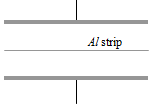
As shown in the figure, a very thin sheet of aluminium is placed in between the plates of the condenser. Then the capacity
|
(a) Will increase |
(b) Will decrease |
|
(c) Remains unchanged |
(d) May increase or decrease |
A cube of side b has a charge q at each of its vertices. The electric field due to this charge distribution at the centre of this cube will be
|
(a) |
(b) |
(c) |
(d) Zero |
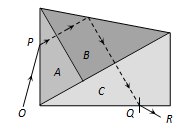
Three glass prisms A, B and C of same refractive index are placed in contact with each other as shown in figure, with no air gap between the prisms. Monochromatic ray of light OP passes through the prism assembly and emerges as QR. The conditions of minimum deviation is satisfied in the prisms
|
(a) A and C |
(b) B and C |
|
(c) A and B |
(d) In all prisms A, B and C |


