MCQ
Which of the following has zero average value in a plane electromagnetic wave?
- AKinetic energy
- BMagnetic field
- CElectric field
- DBoth (b) and (©)
Explanation:
The average of $\sin\theta$ and $\cos\theta$ for whole cycle is is zero.
Step 1: Analyzing the average value of Kinetic energy.
Kinetic Energy is always a positive quantity, therefore its average will also be a positive quantity.
Step 2: Finding the average of electric and the magnetic field.
The equations for the electric field and the magnetic field are given as
Generate a complete, print-ready paper with questions like this in minutes — across 16+ boards, with answer keys.
A particle of charge q and mass m moves in a circular orbit of radius r with angular speed ω. The ratio of the magnitude of its magnetic moment to that of its angular momentum depends on
|
(a) ω and q |
(b) ω q and m |
(c) q and m |
(d) ω and m |
The amount of heat produced in a resistor when a current is passed through it can be found using
|
(a) Faraday’s Law |
(b) Kirchhoff’s Law |
(c) Laplace’s Law |
(d) Joule’s Law |
The maximum velocity of an electron emitted by light of wavelength λ incident on the surface of a metal of work function ∅, is (Where h = Planck's constant, m = mass of electron and c = speed of light.)
|
(a) |
(b) |
(c) |
(d) |
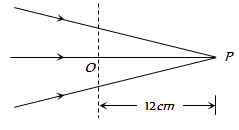
Figure given below shows a beam of light converging at point P. When a convex lens of focal length 16 cm is introduced in the path of the beam at a place O shown by dotted line such that OP becomes the axis of the lens, the beam converges at a distance x from the lens. The value x will be equal to
|
(a) 12 cm |
(b) 24 cm |
(c) 36 cm |
(d) 48 cm |
The ripple factor in a half wave rectifier is
|
(a) 1.21 |
(b) 0.48 |
(c) 0.6 |
(d) None of these |


