MCQ
The magnetic susceptibility for diamagnetic materials is:
- ASmall and negative.
- BSmall and positive.
- CLarge and positive.
- DLarge and negative.
Generate a complete, print-ready paper with questions like this in minutes — across 16+ boards, with answer keys.
The combination of a convex lens (f = 18 cm) and a thin concave lens (f = 9 cm) is
|
(a) A concave lens (f = 18 cm) |
(b) A convex lens (f = 18 cm) |
|
(c) A convex lens (f = 6 cm) |
(d) A concave lens (f = 6 cm) |
A square metallic wire loop of side 0.1 m and resistance of 1W is moved with a constant velocity in a magnetic field of 2 wb/m2 as shown in figure. The magnetic field is perpendicular to the plane of the loop, loop is connected to a network of resistances. What should be the velocity of loop so as to have a steady current of 1mA in loop
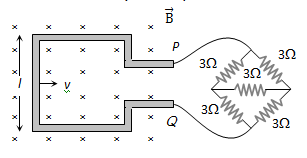
|
(a) 1 cm/sec |
(b) 2 cm/sec |
(c) 3 cm/sec |
(d) 4 cm/sec |
In the figure shown there are two semicircles of radii  and
and  in which a current i is flowing. The magnetic induction at the centre O will be
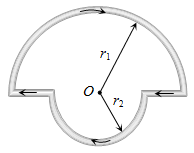
|
(a) |
(b) |
(c) |
(d) |
Work done in moving a positive charge on an equipotential surface is
|
(a) Finite, positive but not zero |
(b) Finite, negative but not zero |
|
(c) Zero |
(d) Infinite |
100 cells each of e.m.f. 5 V and internal resistance 1 ohm are to be arranged so as to produce maximum current in a 25 ohms resistance. Each row is to contain equal number of cells. The number of rows should be
|
(a) 2 |
(b) 4 |
(c) 5 |
(d) 10 |
Which one of the following have minimum wavelength
|
(a) Ultraviolet rays |
(b) Cosmic rays |
(c) X-rays |
(d) γ - rays |
For total internal reflection to take place, the angle of incidence i and the refractive index μ of the medium must satisfy the inequality
|
(a) |
(b) |
(c) sin i < |
(d) sin i > |
Assertion : Different colours travel with different speed in vacuum.
Reason : Wavelength of light depends on refractive index of medium.
|
(a) If both assertion and reason are true and the reason is the correct explanation of the assertion. |
|
(b) If both assertion and reason are true but reason is not the correct explanation of the assertion. |
|
(c) If assertion is true but reason is false. |
|
(d) If assertion is false but reason is true. |


