MCQ
The magnetic susceptibility for diamagnetic materials is:
  • Small and negative.
  • B
    Small and positive.
  • C
    Large and positive.
  • D
    Large and negative.

Answer

Correct option: A.
Small and negative.

Need a full question paper?

Generate a complete, print-ready paper with questions like this in minutes — across 16+ boards, with answer keys.

Start Generating Free

Similar questions

$A$ parallel coherent beam of light falls on fresnel biprism of refractive index $\mu$ and angle $\alpha$ . The fringe width on a screen at a distance $D$ from biprism will be (wavelength $= \lambda $)
If a transparent medium of refractive index $\mu = 1.5$ and thickness $t = 2.5 × 10^{-5}$ m is inserted in front of one of the slits of Young’s Double Slit experiment, how much will be the shift in the interference pattern? The distance between the slits is $0.5\, mm$ and that between slits and screen is $100\, cm$   ..........$cm$
Due to the earth's magnetic field, charged cosmic ray particles
The charge per unit length of the four quadrant of the ring is $2\ \lambda , - 2\ \lambda , \lambda$ and $- \lambda$ respectively. The electric field at the centre is
A light ray falls on a glass surface of refractive index $\sqrt{3}$, at an angle $60^{\circ}$. The angle between the refracted and reflected rays would be ....... $^o$
The stopping potential for the photo electrons emitted from a metal surface of work function $1.7\, eV$ is $10.4\, V$. Identify the energy levels corresponding to the transitions in hydrogen atom which will result in emission of wavelength equal to that of incident radiation for the above photoelectric effect
Magnetic induction is a
In $NPN$ transistor the collector current is $20\, mA$. If $90\%$ of electrons emitted reach the collector, then
A charge $"Q"$ and $"2Q"$ are $0.05$ meters apart and isolated. The ratio of the electrostatic force on the charge $Q$ to the force on charge $2Q$ is:
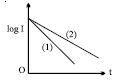
A capacitor of capacity $C$ is charged to a steady potential difference $V$ and connected in series with an open key and a pure resistor $'R'$. At time $t = 0$, the key is closed. If $I =$ current at time $t$, a plot of log $I$ against $'t'$ is as shown in $(1)$ in the graph. Later one of the parameters i.e. $V, R$ or $C$ is changed keeping the other two constant, and the graph $(2)$ is recorded. Then