Question
The magnetic susceptibility is negative for

Answer

(b) The magnetic susceptibility indicates whether a material is repelled out or attracted of a magnetic field. It is negative only for diamagnetic material. It is positive for paramagnetic material and ferromagnetic material has large positive magnetic susceptibility

Need a full question paper?

Generate a complete, print-ready paper with questions like this in minutes — across 16+ boards, with answer keys.

Start Generating Free

Similar questions

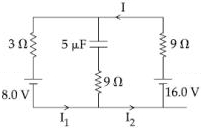
The circuit shown here has two batteries of $8.0\,V$ and $16.0\,V$ and three resistors $3\,\Omega ,\,9\,\Omega $ and $9\,\Omega $ and a capacitor of $5.0\,\mu F.$

How much is the current $I$ in the circuit in steady state? ................... $A$
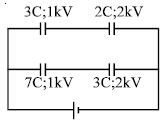
The diagram shows four capacitors with capacitances and break down voltages as mentioned. What should be the maximum value of the external emf source such that no capacitor breaks down ? .......$kV$
A carnot engine has the same efficiency between $800 K$ to $500 K$ and $x\, K$ to $600 K.$ The value of $x$ is ...... $K$
In an apparatus, the electric field was found to oscillate with an amplitude of $18 V/m. $ The magnitude of the oscillating magnetic field will be
A proton is projected with velocity $\overrightarrow{ V }=2 \hat{ i }$ in a region where magnetic field $\overrightarrow{ B }=(\hat{i}+3 \hat{j}+4 \hat{k})\; \mu T$ and electric field $\overrightarrow{ E }=10 \hat{ i } \;\mu V / m .$ Then find out the net acceleration of proton (in $m / s ^{2}$)
Radius of orbit of satellite of earth is $R$. Its kinetic energy is proportional to
A $50\,V$ battery is connected across a $10\, ohm$ resistor. The current is $4.5\, amperes$. The internal resistance of the battery is ............. $ohm$
${f_V}$ and ${f_R}$ are the focal lengths of a convex lens for violet and red light respectively and ${F_V}$ and ${F_R}$ are the focal lengths of a concave lens for violet and red light respectively, then
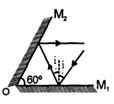
Two plane mirror are inclined to one another at an angle of $60^o$ . A ray is incident on mirror $M_1$ at an angle $i$. The reflected ray from mirror $M_1$ is shown in figure. The angle of incidence $i$ is
A particle starting from rest, moves in a circle of radius $r$. It attains a velocity of $\mathrm{V}_{0} \;\mathrm{m} / \mathrm{s}$ in the $\mathrm{n}^{\text {th }}$ round. Its angular acceleration will be