Question
The magnetic susceptibility is negative for(a) Paramagnetic materials(b) Diamagnetic materials(c) Ferromagnetic materials(d) Paramagnetic and ferromagnetic materials


Answer

(b) Diamagnetic materials

Need a full question paper?

Generate a complete, print-ready paper with questions like this in minutes — across 16+ boards, with answer keys.
Start Generating Free

Similar questions

A body can be negatively charged by(a) Giving excess of electrons to it(b) Removing some electrons from it(c) Giving some protons to it(d) Removing some neutrons from it
   
   
The spectrum of radiation $1.0{\times 10^{14} Hz}$ is in the infrared region. The energy of one photon of this in joules will be
In Young’s double slit experiment, the two slits act as coherent sources of equal amplitude A and wavelength l. In another experiment with the same set up the two slits are of equal amplitude A and wavelength l but are incoherent. The ratio of the intensity of light at the mid-point of the screen in the first case to that in the second case is(a) 1 : 2   (b) 2 : 1(c) 4 : 1    (d) 1 : 1
       
A uniform magnetic field $B$ is acting from south to north and is of magnitude $1.5 \ \mathrm{wb} / \mathrm{m}^2.$ It a proton having mass $=1.7 \times 10^{-27} \mathrm{~kg}$ and charge $=1.6 \times 10^{-19} \mathrm{C}$ moves in this field vertically downwards with energy $5 \ \text{MeV},$ then the force acting on it will be
The correct relation is $($Where $B_H=$ Horizontal component of earth's magnetic field $;\mathrm{B}_{\mathrm{V}} =$ Vertical component of earth's magnetic field and $\mathrm{B}=$ Total intensity of earth's magnetic field$)$
The neutron was discovered by:
Charge $q$ is distributed on two spheres of radii $r_1$ and $r_2$ in such a way that they have the same surface density. Ratio in their potential :
If paramagnetic susceptibility $\chi$ of a substance is 9 then its relative permeability $\mu_r$ is :
The field lines of a single positive charge are:
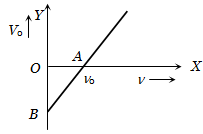
In an experiment on photoelectric effect the frequency $f$ of the incident light is plotted against the stopping potential $V_0$ . The work function of the photoelectric surface is given by $(e$ is electronic charge$)$