Question
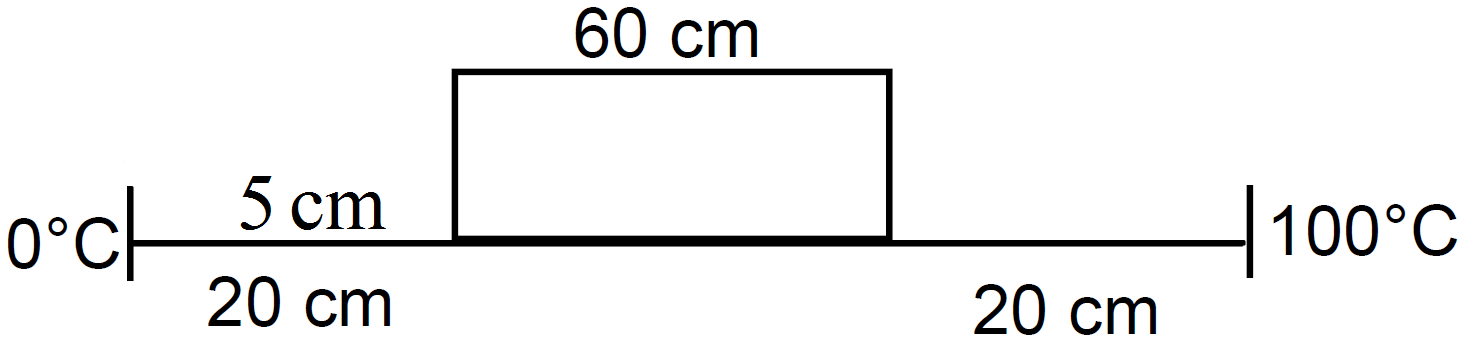
The magnetometer of the previous problem is used with the same magnet in $\tan-\text{B}$ position. Where should the magnet be placed to produce a 37° deflection of the needle?

Answer

Given $\frac{\text{M}}{\text{B}_\text{H}}=40\text{A-m}^2/\text{T}$ Since the magnet is short ‘ℓ’ can be neglectedSo, $\frac{\text{M}}{\text{B}_\text{H}}=\frac{4\pi}{\mu_0}\times\frac{\text{d}^3}{2}=40$
$\Rightarrow\text{d}^3=\frac{40\times4\pi\times10^{-7}\times2}{4\pi}=8\times10^{-6}$
$\Rightarrow\text{d}=2\times10^{-2}\text{m}=2\text{cm}$
with the northpole pointing towards south.

Need a full question paper?

Generate a complete, print-ready paper with questions like this in minutes — across 16+ boards, with answer keys.

Start Generating Free

Similar questions

Why is the linear portion of the triode characteristic chosen to operate the triode as an amplifier?
TV signals broadcast by Delhi studio cannot be directly received at Patna which is about 1000km away. But the same signal goes some 36000km away to a satellite, gets reflected and is then received at Patna. Explain.
A plate current of 10mA is obtained when 60 volts are applied across a diode tube. Assuming the Langmuir-Child equation $\text{i}_\text{p}\propto\text{V}_\text{p}^{\frac{3}{2}}$ to hold, find the dynamic resistance $\text{r}_\text{p}$ in this operating condition.
At a prayer meeting, the disciples sing JAI-RAM JAI-RAM. The sound amplified by a loudspeaker comes back after reflection from a building at a distance of 80m from the meeting. What maximum time interval can be kept between one JAI-RAM and the next JAI-RAM so that the echo does not disturb a listener sitting in the meeting. Speed of sound in air is 320m/s.
If the temperature of a tungsten filament is raised from 2000K to 2010K, by what factor does the emission current change? Work function of tungsten is 4.5eV.
50cc of oxygen is collected in an inverted gas jar over water. The atmospheric pressure is 99.4kPa and the room temperature is 27°C. The water level in the jar is same as the level outside. The saturation vapour pressure at 27°C is 3.4kPa. Calculate the number of moles of oxygen collected in the jar.
When you push your bicycle up on an incline the potential energy of the bicyle and yourself increases. Where does this energy come from?
Read the passage given below and answer the following questions from 1 to 5. Newton’s first law of motion states that If the net external force on a body is zero, its acceleration is zero. Acceleration can be non zero only if there is a net external force on the body. To summaries, if the net external force is zero, a body at rest continues to remain at rest and a body in motion continues to move with a uniform velocity. This property of the body is called inertia. Inertia means ‘resistance to change’. A body does not change its state of rest or uniform motion, unless an external force compels it to change that state. In other words, all objects resist a change in their state of motion. In a qualitative way, the tendency of undisturbed objects to stay at rest or to keep moving with the same velocity is called inertia. Consider a book at rest on a horizontal surface. It is subject to two external forces: the force due to gravity (i.e. its weight W) acting downward and the upward force on the book by the table, the normal force R. R is a self-adjusting force. This is an example of the kind of situation mentioned above. The forces are not quite known fully but the state of motion is known. We observe the book to be at rest. Therefore, we conclude from the first law that the magnitude of R equals that of W. A statement often encountered is : Since W = R, forces cancel and, therefore, the book is at rest”. This is incorrect reasoning. The correct statement is: “Since the book is observed to be at rest, the net external force on it must be zero, according to the first law. This implies that the normal force R must be equal and opposite to the weight W.
  1. The book on table is at rest. The force of gravity here is balanced by:
  1. Force of friction.
  2. Normal reaction by table on book.
  3. Weight of table.
  4. None of these.
  1. If no external force acts on object which is at rest. it will
  1. Remain at rest.
  2. Start to move.
  3. Both a and b can possible.
  4. None of these.
  1. Define inertia.
  1. State Newton’s first law of motion.
  1. Explain why book on table remains at rest.
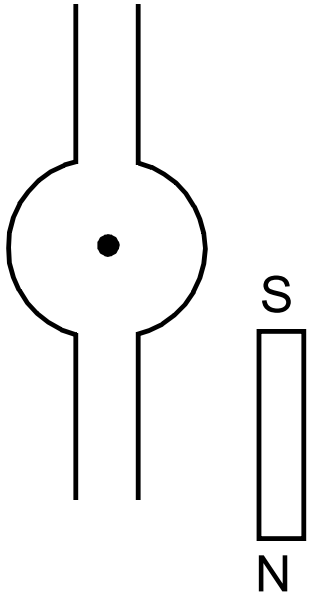
Consider the situation shown in figure. The frame is made of the same material and has a uniform cross-sectional area everywhere. Calculate the amount of heat flowing per second through a cross section of the bent part if the total heat taken out per second from the end at 100°C is 130J.