Question
The magnetometer of the previous problem is used with the same magnet in $\tan-\text{B}$ position. Where should the magnet be placed to produce a 37° deflection of the needle?
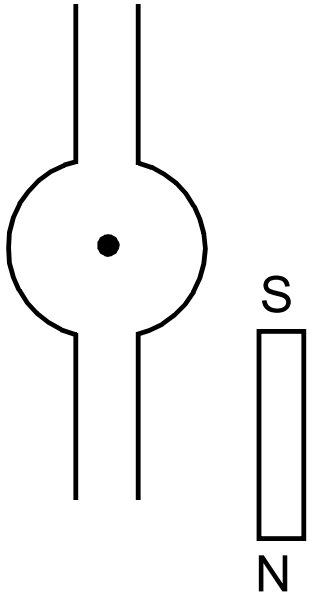
Answer

Given $\frac{\text{M}}{\text{B}_\text{H}}=40\text{A-m}^2/\text{T}$
Since the magnet is short ‘ℓ’ can be neglected
So, $\frac{\text{M}}{\text{B}_\text{H}}=\frac{4\pi}{\mu_0}\times\frac{\text{d}^3}{2}=40$
$\Rightarrow\text{d}^3=\frac{40\times4\pi\times10^{-7}\times2}{4\pi}=8\times10^{-6}$
$\Rightarrow\text{d}=2\times10^{-2}\text{m}=2\text{cm}$
with the northpole pointing towards south.

Need a full question paper?

Generate a complete, print-ready paper with questions like this in minutes — across 16+ boards, with answer keys.
Start Generating Free

Similar questions

A deflection magnetometer is placed with its arms in north-south direction. How and where should a short magnet having $\frac{\text{M}}{\text{B}_\text{H}}=40\text{A-m}^2\text{T}$ be placed so that the needle can stay in any position?
If we allow radiations of a fixed frequency to fall on plate and the accelerating potential difference between the two electrodes is kept fixed, then the photoelectric current is found to increase linearly with the intensity of incident radiation. Here, radiation pressure is $\text{P}=\Big(\frac{1+\text{e}}{\text{C}}\Big)\text{I}$. As, atmosphere pressure at sea level is $10^5Pa.$ If the intensity of light of a given wavelength, is increased, there is an increase in the number of photons incident on a given area in a given time. But the energy of each photon remain the same.
  1. The number of photons hitting the cone second
  1. $\frac{\pi\text{R}^2\text{I}}{2\text{E}}$
  2. $\frac{2\pi\text{R}^2\text{I}}{\text{E}}$
  3. $\frac{\pi\text{R}^2\text{I}}{4\text{E}}$
  4. $\frac{\pi\text{R}^2\text{I}}{\text{E}}$
  1. A radiation of energy E falls normally on a perfect reflecting surface. The momentum transferred to the surface is:
  1. $\frac{\text{E}}{\text{c}}$
  2. $\frac{2\text{E}}{\text{c}}$
  3. $\text{Ec}$
  4. $\frac{\text{E}}{\text{c}^2}$
  1. Which one is correct?
  1. $\text{E}^2=\text{p}^2\text{c}^2$
  2. $\text{E}^2=\text{p}^2\text{c}$
  3. $\text{E}^2=\text{p}^2$
  4. $\text{E}^2=\frac{\text{p}^2}{\text{c}^2}$
  1. The incident intensity on a horizontal surface at sea level from the Sun is about $1k\ Wm^{-2}$. Assuming that 50% of this intensity is reflected and 50% is absorbed, determine the radiation pressure on this horizontal surface.
  1. $8.2 \times 10^{-2}$ Pa
  2. $5 \times 10^{-6}$ Pa
  3. $3 \times 10^{-5}$ Pa
  4. $3 \times 10^{-5}$ Pa
  1. Find the ratio of radiation pressure to atmospheric pressure $P_0$ about $1 \times 10^5$ Pa at sea level.
  1. $5 \times 10^{-11}$
  2. $4 \times 10^{-8}$
  3. $6 \times 10^{-12}$
  4. $8 \times 10^{-11}$
A person's skin is more severely burnt when put in contact with 1g of steam at 100°C than when put in contact with 1g of water at 100°C. Explain.
A metallic loop is placed in a nonuniform magnetic field. Will an emf be induced in the loop?
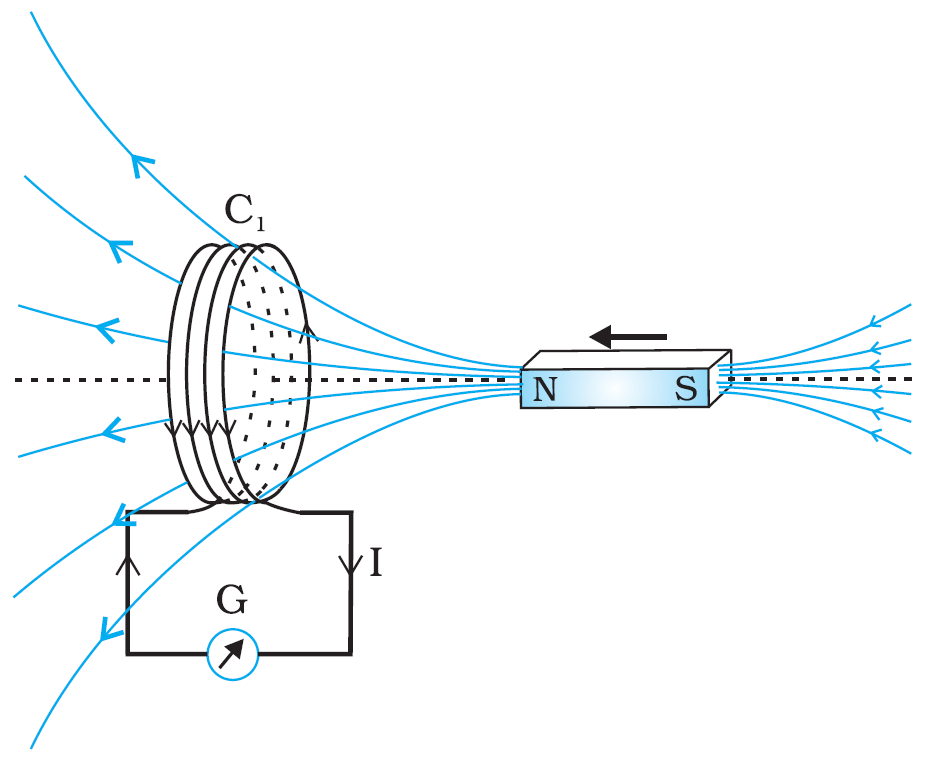
In year 1820 Oersted discovered the magnetic effect of current. Faraday gave the thought that reverse of this phenomenon is also possible i.e., current can also be produced by magnetic field. Faraday showed that when we move a magnet towards the coil which is connected by a sensitive galvanometer. The galvanometer gives instantaneous deflection showing that there is an electric current in the loop. Whenever relative motion between coil and magnet takes place an emf induced in coil. If coil is in closed circuit then current is also induced in the circuit. This phenomenon is called electromagnetic induction.
  1. The north pole of a long bar magnet was pushed slowly into a short solenoid connected to a galvanometer. The magnet was held stationary for a few seconds with the north pole in the middle of the solenoid and then withdrawn rapidly. The maximum deflection of the galvanometer was observed when the magnet was:
  1. Moving towards the solenoid.
  2. Moving into the solenoid.
  3. At rest inside the solenoid.
  4. Moving out of the solenoid.
  1. Two similar circular loops carry equal currents in the same direction. On moving the coils further apart, the electric current will.
  1. Remain unaltered.
  2. Increases in one and decreases in the second.
  3. Increase in both.
  4. Decrease in both.
  1. A closed iron ring is held horizontally and a bar magnet is dropped through the ring with its length along the axis of the ring. The acceleration of the falling magnet is.
  1. Equal to g.
  2. Less than g.
  3. More than g.
  4. Depends on the diameter of the ring and length of magnet.
  1. Whenever there is a relative motion between a coil and a magnet, the magnitude of induced emf set up in the coil does not depend upon the:
  1. Relative speed between the coil and magnet.
  2. Magnetic moment of the coil.
  3. Resistance of the coil.
  4. Number of turns in the coil.
  1. A coil of metal wire is kept stationary in a non-uniform magnetic field:
  1. A n emf and current both are induced in the coil.
  2. A current but no emf is induced in the coil.
  3. An emf but no current is induced in the coil.
  4. Neither emf nor current is induced in the coil.
The magnetic moment of the assumed dipole at the earth's centre is $8.0 \times 10^{22}A-m^2$. Calculate the magnetic field B at the geomagnetic poles of the earth. Radius of the earth is 6400km.
You are holding a cage containing a bird. Do you have to make less effort if the bird flies from its position in the cage and manages to stay in the middle without touching the walls of the cage? Does it make a difference whether the cage is completely closed or it has rods to let air pass?
Why don't we have interference when two candles are placed close to each other and the intensity is seen at a distant screen? What happens if the candles are replaced by laser sources?
Sunita and her friends visited an exhibition. The policeman asked them to pass through a metal detector. Sunita’s friends were initially scared of it. Sunita, however, explained to them the purpose and working of the metal detector.
Answer the following questions:
  1. On what principle does a metal detector work?
  2. Why does the detector emit sound when a person carrying any metallic object walks through it?
  3. State any two qualities which Sunita displayed while explaining the purpose of walking through the detector.