MCQ
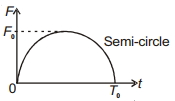
The magnitude of force acting on a particle moving along $x$-axis varies with time $(t)$ as shown in figure. If at $t=0$ the velocity of particle is $v_0$, then its velocity at $t=T_0$ will be
  • $v_0+\frac{\pi F_0 T_0}{4 m}$
  • B
    $v_0+\frac{\pi F_0}{2 m}$
  • C
    $v_0+\frac{\pi T_0^2}{4 m}$
  • D
    $v_0+\frac{\pi F_0 T_0}{m}$

Answer

Correct option: A.
$v_0+\frac{\pi F_0 T_0}{4 m}$
a
(a)

$\int F d t=m \Delta v$

$\int F d t$ is area under $F-t$ curve

$m \Delta v \left.=\pi\left(\frac{F_0}{2}\right) \cdot\left(\frac{T_0}{2}\right) \text { [area }=\frac{\pi a b}{2}\right]$

$v-v_0 =\frac{\pi F_0 T_0}{4 m}$

$v=v_0+\frac{\pi F_0 T_0}{4 m}$

Need a full question paper?

Generate a complete, print-ready paper with questions like this in minutes — across 16+ boards, with answer keys.

Start Generating Free

Similar questions

A force of $5\, N$, making an angle $\theta $ with the horizontal, acting on an object displaces it by $0.4\,m$ along the horizontal direction. If the object gains kinetic energy of $1\,J$, the horizontal component of the force is......$N$
A body is released from the top of a tower of height $H\, metre$. After $2\, seconds$ it is stopped and then instantaneously released. What will be its height after next $2\, seconds$ ?
If water is flowing in a pipe with speed $2 \,m / s$ then its kinetic energy per unit volume is ........... $J ^2 m ^3$
If on heating liquid through $80°C$, the mass expelled is $(1/100)^{th}$ of mass still remaining, the coefficient of apparent expansion of liquid is
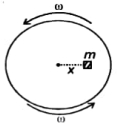
A block of mass $m$ is kept on horizontal turn table at $x$ distance from the centre. If coefficient of friction between block and surface of turn table is $\mu$, then maximum angular speed of the table so that block does not slip
Ten tuning forks are arranged in increasing order of frequency in such a way that any two consecutive tuning forks produce $4$ beats per second. The highest frequency is twice that of the lowest. Possible highest and lowest frequencies (in $Hz$ ) are ................
In isothermal process, the work done per gram molecule of gas is:
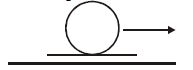
A ball rests upon a flat piece of paper on a table top. The paper is pulled horizontally but quickly towards right as shown. Relative to its initial position with respect to the table, the ball

$(A)$ Remains stationary if there no friction between the paper and the ball

$(B)$ Moves to the left and starts rolling backwards, $i.e.$, to the left if there is a friction between the paper and the ball

$(C)$ Moves foward, $i.e.$ in the direciton in 'which the paper is pulled

Here, the correct statements is/are

The correct relation is
$Assertion$ : In a free fall, weight of a body becomes effectively zero.

$Reason$ : Acceleration due to gravity acting on a body having free fall is zero.