MCQ
The magnitude of the displacement is equal to the distance covered in a given interval of time if the particle
  • A
    moves with constant acceleration
  • B
    moves with constant speed
  • moves with constant velocity
  • D
    none of the above

Answer

Correct option: C.
moves with constant velocity
c
To cover the distance equal to magnitude of displacement, the particle has to move with constant velocity.

Need a full question paper?

Generate a complete, print-ready paper with questions like this in minutes — across 16+ boards, with answer keys.
Start Generating Free

Similar questions

Mass of a person sitting in a lift is $50\, kg$. If lift is coming down with a constant acceleration of $10 \,m/se{c^2}.$ Then the reading of spring balance will be ......... $N$ $(g = 10m/se{c^2})$  
Two bodies $A$ (of mass $1\,kg$) and $B$ (of mass $3\,kg$) are dropped from heights of $16\,m$ and $25\,m$ respectively . The ratio of the time taken by them to reach the ground is 
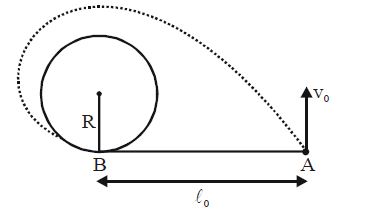
A horizontal plane supports a stationary vertical cylinder of radius $R = 1\ m$ and a disc $A$ attached to the cylinder by a horizontal thread $AB$ of length $l_0 = 2\ m$ (seen in figure, top view). An intial velocity ($v_0 = 1\ m/s$) is imparted $AB$ to the disc as shown in figure. .......... $\sec$ long will it move along the plane until it strikes against the cylinder ? (All surface are assumed to be smooth)
A real gas within a closed chamber at $27^{\circ} \mathrm{C}$ undergoes the cyclic process as shown in figure. The gas obeys $P V^3=\mathrm{RT}$ equation for the path $A$ to $B$. The net work done in the complete cycle is (assuming $R=8 \mathrm{~J} / \mathrm{molK}$ ):
A particle, initially at rest on a frictionless horizontal surface, is acted upon by a horizontal force which is constant in size and direction. A graph is plotted between the work done $(W) $ on the particle, against the speed of the particle, $(v)$. If there are no other horizontal forces acting on the particle the graph would look like
Select wrong statement about pressure ..........
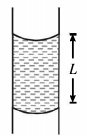
A vertical glass capillary tube of radius $r$ open at both ends contains some water (surface tension $T$ and density $\rho$ ). If $L$ be the length of the water column, then:
A solid cylinder of mass $M$ and radius $R$ rolls without slipping down an inclined plane of length $L$ and height $h$.  What is the speed of its centre of mass when the cylinder reaches its bottom 
The quantities which have the same dimensions as those of solid angle are:
If the breaking force for a given wire is $F$, If the thickness of the wire is doubled, then the breaking force will be