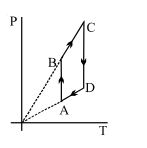
- A$225 \mathrm{~J}$
- ✓$205 \mathrm{~J}$
- C$20 \mathrm{~J}$
- D$-20 \mathrm{~J}$
$=\int \frac{\mathrm{RTdV}}{\mathrm{V}^3}$
$=\mathrm{RT} \int_2^4 \mathrm{~V}^{-3} \mathrm{dV}$
$=8 \times 300 \times\left(-\frac{1}{2}\left[\frac{1}{4^2}-\frac{1}{2^2}\right]\right)$
$=225 \mathrm{~J}$
$\mathrm{~W}_{\mathrm{BC}} =\mathrm{P} \int_4^2 \mathrm{dV}=10(2-4)=-20 \mathrm{~J}$
$\mathrm{~W}_{\mathrm{CA}} =0$
$\therefore \mathrm{W}_{\text {cyck }} =205 \mathrm{~J}$
Note: Data is inconsistent in process $A B$.
So needs to be challenged.
Generate a complete, print-ready paper with questions like this in minutes — across 16+ boards, with answer keys.

Assertion $(A)$ : Time period of oscillation of a liquid drop depends on surface tension $(S)$, if density of the liquid is $p$ and radius of the drop is $r$, then $T = k \sqrt{ pr ^{3} / s ^{3 / 2}}$ is dimensionally correct, where $K$ is dimensionless.
Reason $(R)$: Using dimensional analysis we get $R.H.S.$ having different dimension than that of time period.
In the light of above statements, choose the correct answer from the options given below.
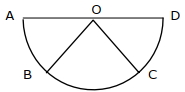
Reason $R$ : Polygon law of vector addition yields $\overrightarrow{A B}+\overrightarrow{B C}+\overrightarrow{C D}+\overrightarrow{A D}=2 \overrightarrow{A O}$
In the light of the above statements, choose the most appropriate answer from the options given below
$[Image]$
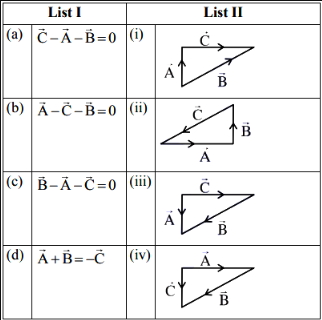
Choose the correct answer from the options given below :