MCQ
The main cause of avalanche breakdown is:
- AIonisation by collision.
- BHigh doping.
- CRecombination of electrons and holes.
- DLow doping.
Explanation:
Avalanche breakdown is caused by impact ionization of electron-hole pairs. A very little current flows under reverse bias conditions and depletion region increases. The electric field in the depletion region of a diode can be very high. Electron/holes that enter the depletion region undergo a tremendous acceleration.
As these accelerated carriers collide with the atoms, they can knock electrons from their bonds, creating additional electron/hole pairs and thus additional current. As these secondary carriers are swept into the depletion region, they too are accelerated and the process repeats itself.
Generate a complete, print-ready paper with questions like this in minutes — across 16+ boards, with answer keys.
An electric lamp is marked 60 W, 230 V. The cost of 1 kilowatt hour of power is Rs. 1.25. The cost of using this lamp for 8 hours is
|
(a) Rs. 1.20 |
(b) Rs. 4.00
|
(c) Rs. 0.25 |
(d) Rs. 0.60 |
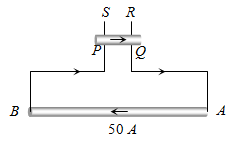
A long wire AB is placed on a table. Another wire PQ of mass 1.0 g and length 50 cm is set to slide on two rails PS and QR. A current of 50A is passed through the wires. At what distance above AB, will the wire PQ be in equilibrium
|
(a) 25 mm |
(b) 50 mm |
(c) 75 mm |
(d) 100 mm |
A lens (focal length 50 cm) forms the image of a distant object which subtends an angle of 1 milliradian at the lens. What is the size of the image
|
(a) 5 mm |
(b) 1 mm |
(c) 0.5 mm |
(d) 0.1 mm |
The nature of binding for a crystal with alternate and evenly spaced positive and negative ions is
|
(a) Covalent |
(b) Metallic |
(c) Dipolar |
(d) Ionic |