MCQ
The Martians use force $(F)$, acceleration $$ and time $(T)$ as their fundamental physical quantities. The dimensions of length on Martians system are
  • A
    $F T^2$
  • B
    $F^{-1} T^2$
  • C
    $F^{-1} A^2 T^{-1}$
  • $A T^2$

Answer

Correct option: D.
$A T^2$
(d) Acceleration $=\frac{\text { distance }}{\text { time }^2} \Rightarrow A=L T^{-2}\Rightarrow L=A T^2$

Need a full question paper?

Generate a complete, print-ready paper with questions like this in minutes — across 16+ boards, with answer keys.
Start Generating Free

Similar questions

A body of mass $6 \mathrm{~kg}$ is under a force which causes displacement in it given by $S=\frac{t^2}{4}$ metres where $t$ is time. The work done by the force in 2 seconds is
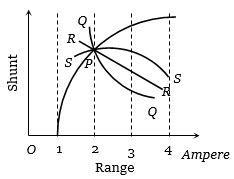
The ammeter has range $1\, ampere$ without shunt. the range can be varied by using different shunt resistances. The graph between shunt resistance and range will have the nature
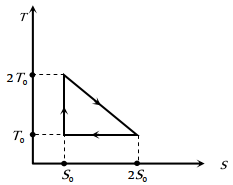
The temperature-entropy diagram of a reversible engine cycle is given in the figure. Its efficiency is

Image

In a region of uniform magnetic induction $B=10^{-2}$ tesla, a circular coil of radius $30 cm$ and resistance $\pi ohm$ is rotated about an axis which is perpendicular to the direction of $B$ and which forms a diameter of the coil. If the coil rotates at $200 rpm$ the amplitude of the alternating current induced in the coil is
Two identical containers $A$ and $B$ with frictionless pistons contain the same ideal gas at the same temperature and the same volume $V$. The mass of the gas in $A$ is $m_A$ and that in $B$ is $m_B$. The gas in each cylinder is now allowed to expand isothermally to the same final volume $2 \mathrm{~V}$. The changes in the pressure in $A$ and $B$ are found to be $\Delta P$ and $1.5 \Delta P$ respectively. Then
If a new planet is discovered rotating around Sun with the orbital radius double that of earth, then what will be its time period (in earth's days)
An electron of mass $m$ when accelerated through a potential difference $V$ has de-Broglie wavelength $\lambda$. The de-Broglie wavelength associated with a proton of mass $M$ accelerated throug the same potential difference will be
During an adiabatic expansion of $2$ moles of a gas, the change in internal energy was found $-50.$ The work done during the process is
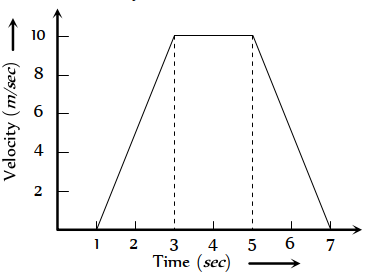
For the velocity-time graph shown in figure below the distance covered by the body in last two seconds of its motion is what fraction of the total distance covered by it in all the seven seconds
Image
"Lux" is a unit of