Question
The mass defect per nucleon is called:

Answer

  1. Packing fraction
Explanation:
Nuclear binding energy can be computed from the difference in mass of a nucleus, and the sum of the masses of the number of free neutrons and protons that make up the nucleus. Once this mass difference, called the mass defect or mass deficiency, is known, Einstein's mass-energy equivalence formula can be used to compute the binding energy of any nucleus.
Early nuclear physicists used to refer to computing this value as a "packing fraction" calculation.

Need a full question paper?

Generate a complete, print-ready paper with questions like this in minutes — across 16+ boards, with answer keys.
Start Generating Free

Similar questions

27 small drops of water with equal radius and equal charge comprised to form one big drop. The ratio of capacitance of a big drop and capacitance of a small drop will be:
Emission spectrum of $CO_2$​ gas:
The kinetic energy force on the particle continuously increases with time.
  1. The resultant force on the particle must be parallel to the velocity at all instants.
  2. The resultant force on the particle must be at an angle less than 90° all the time.
  3. Its height above the ground level must continuously decrease.
  4. The magnitude of its linear momentum is increasing continuously.
The work done by the external forces on a system equals the change in:
  1. Total energy.
  2. Kinetic energy.
  3. Potential energy.
  4. None of these.
The inductance of a resistanceless coil is 0.5 henry. In the coil, the value of alternating current is 0.2 A, whose frequency is 50 Hz. The reactance of circuit is.
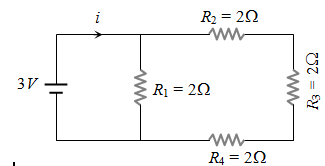
What is the current $(i)$ in the circuit as shown in figure
If the Q value of an endothermic reaction is 11.32MeV, then the minimum energy of the reactant nuclei to carry out the reaction is (in laboratory frame of reference)
The de-Broglie wavelength $\lambda$
$\lambda$ ray of light passes through a prism of refractive index $\sqrt{2}$ in such a way that its angle of incidence is twice of the angle of refraction and there is minimum deviation in the ray. The angle of the prism will be :
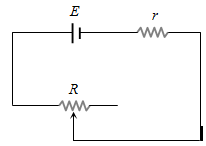
A battery of $\text{e.m.f.}\ E$ and internal resistance $r$ is connected to a variable resistor $R$ as shown here. Which one of the following is true