MCQ
The mass defect per nucleon is called
  • A
    Binding energy
  • Packing fraction
  • C
    Ionisation energy
  • D
    Excitation energy

Answer

Correct option: B.
Packing fraction
b
(b) Nuclear binding energy can be computed from the difference in mass of a nucleus, and the sum of the masses of the number of free neutrons and protons that make up the nucleus. Once this mass difference, called the mass defect or mass deficiency, is known, Einstein's mass-energy equivalence formula can be used to compute the binding energy of any nucleus. Early nuclear physicists used to refer to computing this value as a "packing fraction" calculation.

Need a full question paper?

Generate a complete, print-ready paper with questions like this in minutes — across 16+ boards, with answer keys.
Start Generating Free

Similar questions

The speed of light in media $M_1$ and $M_2$ are $1.5 \times 10^8\,\, m/s$ and $2.0 \times 10^8\,\, m/s$ respectively. A ray of light enters from medium $M_1$ to $M_2$ at an incidence angle $i.$ If the ray suffers total internal reflection, the value of $i$ is
A particle has initial velocity $10\,\, m/s$. It moves due to constant retarding force along the line of velocity which produces a retardation of $5\,\, m/s^2$. Then
An electromagnetic wave travelling in the $x-$ direction has frequency of $2 \times 10^{14}\,Hz$ and electric field amplitude of $27\,Vm^{-1}$ . From the options given below, which one describes the magnetic field for this wave ?
The initial temperature of a body is $80°C$ . If its temperature falls to $64°C$ in $5$ minutes and in $10$ minutes to $52°C$ then the temperature of surrounding will be ...... $^oC$
Water has been filled in a vertical capillary tube upto the top after closing its lower end by a finger. If the finger is removed we shall observe that : ( $T = 70 \,\,dyne/cm,$  radus of capillary $r = 1\,\,mm$ and $g = 980\,\,cm/sec^2$ )
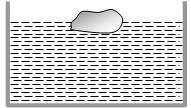
A body floats in a liquid contained in a beaker. The whole system as shown falls freely under gravity. The upthrust on the body due to the liquid is
Four different independent waves are represented by $(i)$ ${y_1} = {a_1}\sin \omega t$ $(ii)$ ${y_2} = {a_2}\sin 2\,\omega t$ $(iii)$ ${y_3} = {a_3}\cos \omega t$ $(iv)$ ${y_4} = {a_4}\sin \left( {\omega t + \frac{\pi }{3}} \right)$ With which two waves interference is possible
The power is transmitted from a power house on high voltage $ac$ because
Two identical coaxial circular loops carry current $i$ each circulating in the clockwise direction. If the loops are approaching each other, then
Which of the following statements are true in case when two water drops collapse and make a bigger drop